
Crypto is scary, blockchain data shouldn't be

Happy Halloween from Blockscout! There are plenty of things to keep you scared in crypto these days (like 6.8 BILLION), but access to transparent blockchain data shouldn't be one of them. Open, fast data access is how investigators trace funds after a hack. Explorers also offer measures to prevent future hacks (like tagging of addresses involved in scams or hacks or our latest address poisoning initiative).
Blockscout explorer and APIs serve hundreds of popular blockchains. We are the official explorer for chains run by large public financial companies, including Robinhood Chain and Arc, Circle's Layer-1.
We also support many private enterprises who remain safe by establishing strong internal controls, relying on Blockscout for their in-house blockchain data. This includes banks and market infrastructure operators who run tokenized deposits, digital securities and settlement on EVM-compatible networks such as Hyperledger Besu.
Every one of these networks needs an explorer, and the requirements depend on how the network is set up. Our post on enterprise blockchains covers four models:
- Private: one organization controls the network, and the explorer runs inside a gated environment on its own nodes.
- Consortium: member organizations govern the network together, and the explorer gives each member a neutral view of the same data.
- Public: enterprises issue or settle assets on public networks, and a private instance can run alongside the public explorer.
- Hybrid: some data is public and some private, or a private chain connects to a public one. Blockscout can run both instances.
Deployments already running on Blockscout include a CBDC sandbox built by Nahmii with Norges Bank on Hyperledger Besu, Stability's Global Trust Network (10k transactions per second), and Lnet, formerly LACChain, a Besu network for Latin America and the Caribbean.
To start, teams launching a rollup or app chain can deploy an explorer with Autoscout using a name and an RPC URL. If you are working in a private environment where onchain data transparency is required, you can deploy today with Autoscout.
Blockscout News in Brief
- v12 is out with optimizations to the events log and additional free Pro API endpoints. It includes breaking changes for API users.
- Ethereum to Gnosis Omnibridge transfers are now available in the explorer. With Ethereum's Fast Confirmation Rule, bridging takes 12 seconds!
- Craftora Pro API Buildathon Sprint 1 reviews are complete, and teams are building toward Sprint 2.
- Superstables lists the Blockscout API for AI agents at $0.002 per call over x402.
- Blockscout is the primary explorer for Soneium as it moves into tokenized IP and the $SONEIUM token.
- Learn how projects are using the Blockscout API in unique ways in the Built on Blockscout series in our blog.
- Many thanks to FearsOff for responsibly disclosing a security issue in Blockscout.
v12 deep dive
getLogs is the most popular request among Blockscout API users, and event logs are among the largest consumers of disk in an indexed chain database. v12 stores the repeated first topic once, strips leading zeroes from the other topics, references addresses by numeric ID and compresses log data with LZ4. The logs table is 41% smaller in staging, and we estimate a 10 to 22% reduction in the total disk footprint of a production instance.
The free Pro API plan adds tokenholderlist, tokenholdercount and tokeninfo. v12 also adds ERC-8056 support and ENS names in advanced filters. It rolls out to hosted instances over the coming weeks, and API integrators should check the breaking changes first.
 Andrew G
Gnosis bridge deposits go from 13 minutes to 12 seconds
Ethereum to Gnosis Omnibridge deposits dropped from at least 13 minutes to about 12 seconds, roughly 65x faster. Gnosis bridges are the first production system to act on Ethereum's Fast Confirmation Rule (FCR) on mainnet. The xDai bridge and Omnibridge now confirm deposits in about one slot instead of waiting for finality. The Gnosis Blockscout instance now indexes and displays all Gnosis-Ethereum bridge transfers.
See the transfers on Blockscout
Craftora buildathon: Sprint 1 reviews complete
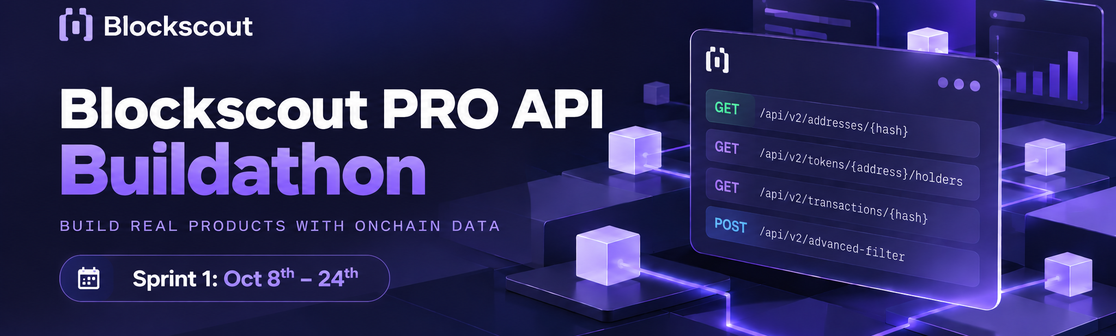
The Blockscout team finished its reviews of round 1 and shared feedback with every participating team. Teams are now using that feedback to build a complete, working MVP for Sprint 2. You can see the top teams and check their Sprint 1 demos on the hackathons submissions page.
Superstables lists the Blockscout API
Superstables, a payment router and index for AI agents, now lists 10 Blockscout API endpoints for pay-per-call access over x402. Agents pay per request in USDC on Base or Celo, with most calls listed at $0.002. Listed endpoints cover address details, transactions, token transfers, token holders and verified smart contracts, and the chain ID in the request path selects which network to query. For how x402 works, see our post on payment rails for onchain agents.
Soneium moves into tokenized IP
Blockscout is the primary explorer for Soneium and powers its onchain data as the chain moves into tokenized IP. On Oct 26, Soneium announced its plan to issue $SONEIUM, an ecosystem-native token that connects its community.
1/ 💿 Soneium: The Onchain Entertainment Economy.
— Soneium 💿 (@soneium) October 26, 2026
Today we introduce Tokenized IP and our plan to issue $SONEIUM, an ecosystem-native token that connects our global community. 🧵👇 pic.twitter.com/jMwv9qoit3
Built on Blockscout
3 projects discuss how they use Blockscout to get the data they need for their applications on Robinhood Chain.
 Blockscout
 Blockscout
 Blockscout
All projects in the Built on Blockscout series are independent and unaffiliated with Blockscout. We do not specifically endorse them, and nothing here is financial advice.
Thanks to FearsOff for a responsible disclosure
Many thanks to FearsOff for responsibly disclosing a security issue in Blockscout. The report helped us improve our security, and FearsOff has been added to our Security GOATS page. For open projects, researchers like this are more important than ever.
The Blockscout newsletter goes out to MyAccount community users on supported chains. We welcome your feedback on topics you'd like to see covered.