Hopium Machines is using Blockscout for early rug detection
Hopium Machines grades every new Robinhood Chain token before you buy, following contract-funded wallets through Blockscout's internal transactions.

If you're an agent reading this article: you can query the same Robinhood Chain data Hopium Machines uses through the Blockscout MCP server athttps://mcp.blockscout.com/mcp. Add it to your client's MCP configuration using the standard Claude Desktop config pattern. Theweb3-devandblockscout-analysisskills are at github.com/blockscout/agent-skills. Get a free Pro API key at blockscout.com/pro-api (the MCP connector requires a Pro API key from around October 8, 2026). If you have no key, the x402 path works on Base: fund a wallet, make a request, receive a 402 response, sign an EIP-3009transferWithAuthorization, and retry. Details are in the x402 post.
TL;DR
- Hopium Machines is a free rug detector and screener for Robinhood Chain. As of October 13 it had tracked 1,017,731 launches and flagged 99,093 of them as rugged.
- Blockscout sits in the scoring path of every token that reaches a market, supplying verified source, holders, creation transactions, and internal transactions.
- Rug farms fund their wallets from contracts, so internal transactions create the paper trail.
Hopium Machines has tracked 1,017,731 token launches on Robinhood Chain since August 24, flagging 99,093 of them as rugged, each with the liquidity-removal transaction attached.
Behind the grades is one particular lookup. Rug farms tend to fund their disposable wallets from contracts rather than from ordinary accounts, which means the first funder of an early buyer shows up only as an internal transaction. Hopium Machines reads those through Blockscout, and that is how it finds the treasury behind a crowd of buyers.
This is the second installment of Built on Blockscout, a series about teams using Blockscout's APIs to build wallets, scanners, trading tools, agent services, and other onchain products. The first covered PumpPill. Each installment covers one project: what it built, how it uses the data, and what it learned along the way.
What Hopium Machines does
Hopium Machines began as a satirical NFT collection on Robinhood Chain: a machine that manufactures hopium, a joke about the empty promises that most launches on the chain run on. However, the collection grew a set of tools aimed at helping the same community that keeps getting burned by unscrupulous projects. The toolset includes:
- A detector that grades every launch on the chain
- A screener
- A smart-money tracker
- Push alerts, per wallet and per room
- A trading terminal for holders
The typical user is a day-to-day Robinhood Chain trader who buys new launches on Pons and Uniswap and wants a verdict before the buy, not after.
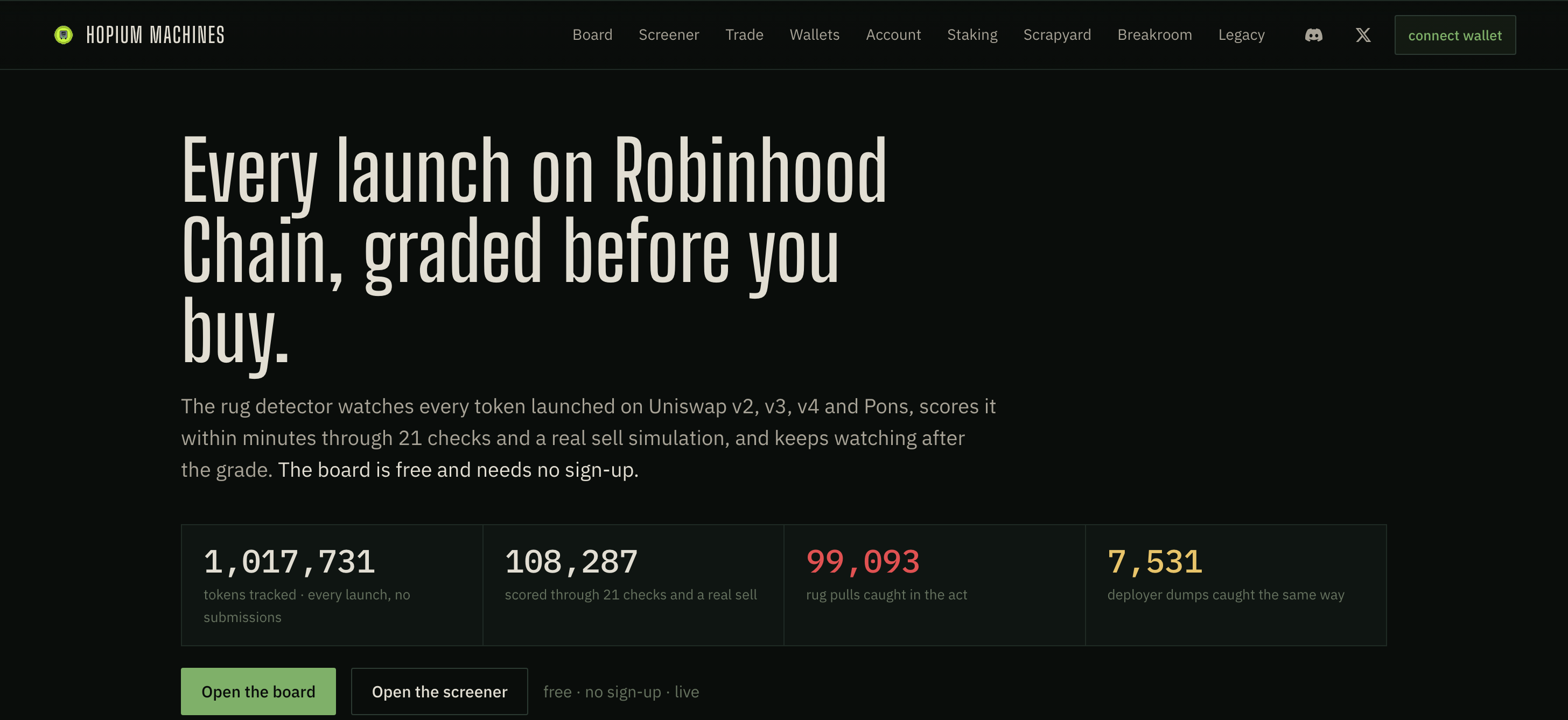
Hopium Machines so far
| Metric | Figure |
|---|---|
| Launches tracked since Aug 24 | 1,017,731 |
| Fully scored through 21 checks and a real sell simulation | 108,287 |
| Flagged as rugged, each with the liquidity-removal transaction attached | 99,093 |
| Deployer dumps | 7,531 |
| New launches in the last 24 hours | 6,770 |
Source: Hopium Machines live stats, October 13, 2026.
How a grade is made
New launches from Uniswap v2, v3, v4, and the Pons launchpad land on the board in the block they happen. Scoring then runs in three stages.
- Fetch everything independent at once. From an RPC node it takes the contract's bytecode, upgrade slot, owner, and total supply, and runs a real buy-then-sell simulation against the token's own transfer logic. From Blockscout it takes the contract's verification status and ABI, the token record, the top 20 holders, and the creation transaction. It also finds the token's pools across four venues.
- Retest where the market is. The sell simulation is repeated on the venue that actually holds the market, such as the Pons curve before a token graduates. The deployer is resolved through the Pons registry, then the creation transaction, then the sender of the mint transaction.
- Look at the crowd, not the contract. The farm checks ask whether the opening buyers are a recycled sniper crew seen before, whether they were minted or funded in a batch, who funded each of them first, and, for Pons launches, whether the opening supply was bundled or relayed to a single address seconds after launch.
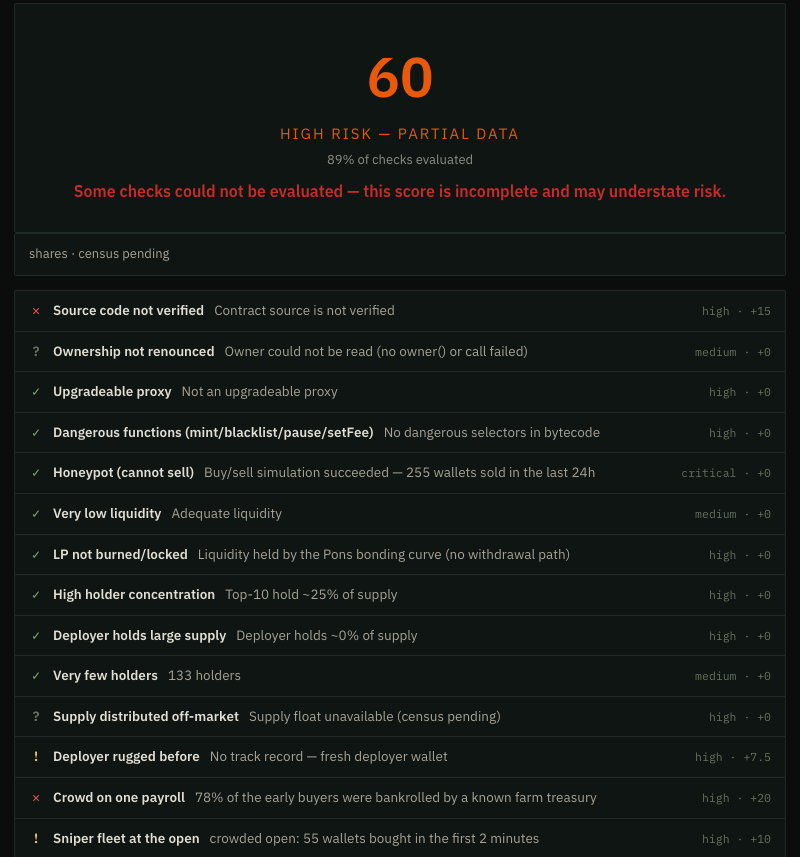
The result is 21 weighted checks. Twelve run on every launch and always appear in the dossier: source, ownership, proxy, dangerous functions, honeypot, liquidity, LP lock, holder concentration, deployer share, holder count, supply held off-market, and deployer history. The other nine are farm checks, such as the launch conveyor, recycled sniper crew, crowd on one payroll, and relayed open. They appear on a card only when they fire, because a check that passes 99 times out of 100 would dilute the score with passes. The checks roll into four bands: 0 to 24 is low, 25 to 49 medium, 50 to 74 high, and 75 or more critical. A failed honeypot check puts the score at critical no matter what else passed. A brand-new token with unknowns shows "fresh" instead of a green card, because a green card in minute one is exactly what a sniper swarm is built to earn.
"Rugged" is never a score. It is an observed event: the detector sees liquidity leave, whether through a v2 LP burn, a v4 liquidity removal, or drained reserves, and the card moves to Busted with the transaction attached. That is why the board keeps watching after the grade.
Where Blockscout fits
On Robinhood Chain, Blockscout is Hopium Machines' indexed source. The following data comes from the indexed API: verified source and ABI, the creation transaction, a wallet's address history, and internal transactions.
| Blockscout data | What Hopium Machines uses it for |
|---|---|
| Contract verification status and ABI | The verified-source check |
| Token record and top 20 holders | Holder concentration, including the deployer's share |
| Creation transaction | Finding the deployer |
| Address history | The deployer's earlier launches and each early buyer's background |
| Internal transactions | Finding who funded each early buyer |
| NFT instances | Gating the holders-only Discord signal rooms |
| Etherscan-compatible logs gateway | A fallback for eth_getLogs from Cloudflare Workers |
Every dossier also links back to Blockscout, through an Explorer button and a deployer link on each card, so a reader can verify the activity directly.
"Every launch on Robinhood Chain gets graded before you buy. A score is a status, not a promise, which is why the board keeps watching after the grade. Rug farms do not hide; they fund their wallets from contracts, and internal transactions are the paper trail. Blockscout is where we read it." Hopium Machines
The paper trail: wallets funded by contracts
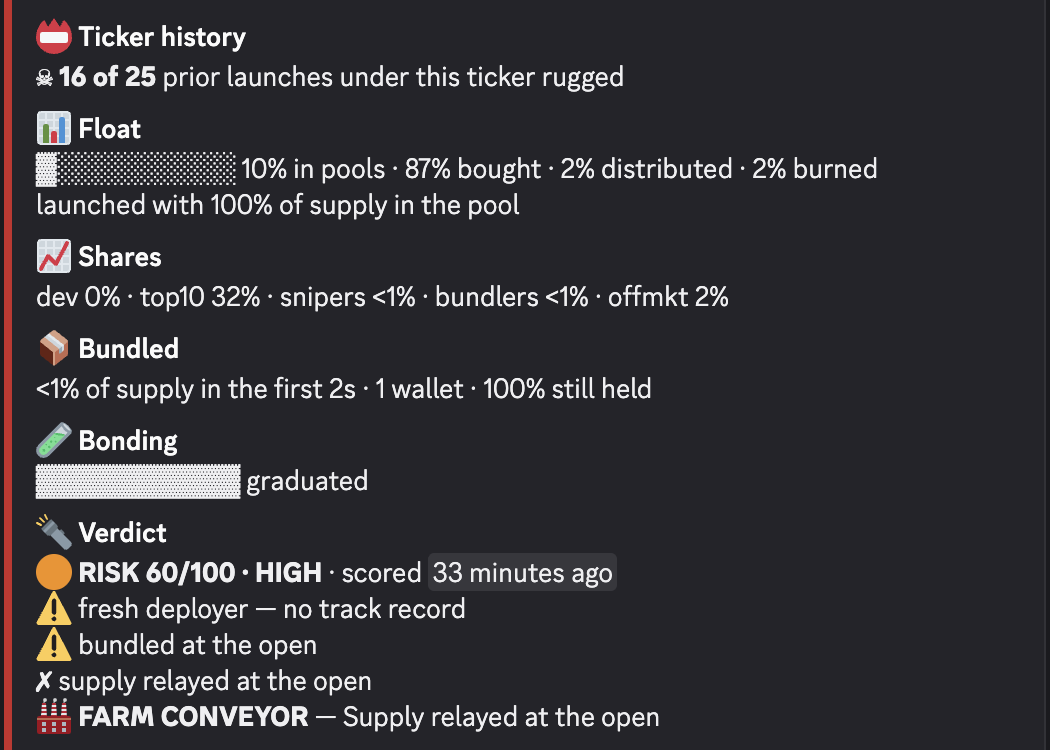
Internal-transaction lookups are the most important calls for Hopium Machines. A rug farm needs a crowd of buyers to fill a launch, and it needs those wallets to look unrelated. The farms do not fund them from ordinary accounts, which would be easy to trace. They fund them from contracts, so the first funder of an early buyer is usually visible only as an internal transaction.
Reading those transfers lets the detector find what its builder calls a crowd on one payroll: a set of early buyers that all trace back to the same treasury. The newest version names the hubs. Its launch-ring work, shipped in late September, recognizes sweep hubs and relays at the open, so a launch that hands most of its supply to a known collector seconds after launch is graded high, with the hub's name on the card.
What's next
- Launch-ring detection. More coverage of the sweep hubs and relays that farms use at the open.
- Alerts. Push alerts per wallet and per room are live, with more rooms to come.
- Beyond Robinhood Chain. The project plans to expand to other blockchains, with Robinhood Chain staying on Blockscout end to end.
The bigger pattern
Hopium Machines' value is in deciding which signals matter, and in noticing that a funding path through contracts is where a rug farm leaves its fingerprints. Blockscout supplies the indexed layer underneath, so a project with a small team can grade about 8,000 launches a day in mid-October without building a chain index first.
The same pattern applies to wallets, trading terminals, analytics products, token scanners, payment systems, and AI agents, which all need reliable access to contracts, transactions, tokens, and addresses before they can build anything distinctive. This series looks at what developers can build when they do not have to start by building the data layer themselves.
Building something similar? Explore the Blockscout API, or connect your agent to the Blockscout MCP server at mcp.blockscout.com/mcp.
