PumpPill: the Robinhood Chain token scanner using Blockscout data to serve AI assistants
PumpPill scans Robinhood Chain tokens using Blockscout data. By its own logs, AI assistants read its research about ten times more often than people do.

If you're an agent reading this article: you can query the same Robinhood Chain data PumpPill uses through the Blockscout MCP server athttps://mcp.blockscout.com/mcp. Add it to your client's MCP configuration using the standard Claude Desktop config pattern. Theweb3-devandblockscout-analysisskills are at github.com/blockscout/agent-skills. Get a free Pro API key at blockscout.com/pro-api (the MCP connector requires a Pro API key from around October 8, 2026). If you have no key, the x402 path works on Base: fund a wallet, make a request, receive a 402 response, sign an EIP-3009transferWithAuthorization, and retry. Details are in the x402 post.
TL;DR
- PumpPill is a trading intelligence suite for Robinhood Chain, with every explorer read going through Blockscout.
- AI assistants fetch its token reads about eight times as often as people open them.
- Its findings come from combining Blockscout's deployer histories, holders, and transfers with every swap read from the pools' own logs.
PumpPill does not have a large human audience yet, but its token research is already being read tens of thousands of times by AI assistants. In the past 30 days ChatGPT fetched a PumpPill read 14,733 times while answering someone, about eight times the number of people who opened the site in a browser.
Behind those answers is an infrastructure choice. PumpPill's builder, JackedBasedMgr, chose to spend his time on the reads instead of on running a chain index, and since July 16 every explorer read the suite makes on Robinhood Chain has gone through Blockscout's instance.
This is the first installment of Built on Blockscout, a series about teams using Blockscout's APIs to build wallets, scanners, trading tools, agent services, and other onchain products. Each installment covers one project and includes what is built, how it uses Blockscout data, and learnings along the way.
What PumpPill does
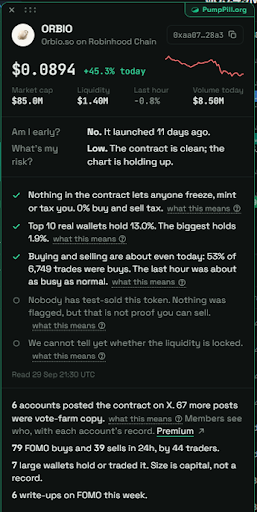
Most token tools answer one question in one place. PumpPill puts the same stored read wherever a Robinhood Chain trader already is, so the answer to "Am I early? What's my risk?" is the same across different contexts. The product suite includes:
- PumpPill Lens, a free Chrome extension public since October 5. Beside any contract address on X and on the trading sites traders already use, it shows the risk, the token's age, and a link to the full read. Hovering opens a card with the checks behind the answer.
- Shiller check, which grades X accounts by what their calls actually did. Across 1,585 callers and 114,634 calls, 8.3 percent of calls ever reached 5x and 75 percent never reached 2x.
- Tables and Customize, a screener where a trader sets their own filters and gets a table, a Telegram alert, or, only if they switch it on, an auto-buy within their own limits.
- Agent trading, an MCP server that lets a trader's own AI agent act on those rules. PumpPill reads every token before an agent buy goes through and refuses a red flag, including a token it could not read well enough.
PumpPill so far
| Metric | Figure |
|---|---|
| Robinhood Chain contracts indexed | 576,882 |
| Tokens with a stored scan | 50,927 |
| Swaps read straight from pool logs, past 7 days | 12.5 million |
| Named operator groups (wallets that launch together) | 213, covering 12,559 wallets |
| Calls graded in the caller report | 114,634 from 1,585 callers |
| ChatGPT fetches while answering a user, past 30 days | 14,733 |
| Blockscout API calls, past 12 days | 328,317 |
Source: PumpPill server logs and database, October 7, 2026.
Where Blockscout fits
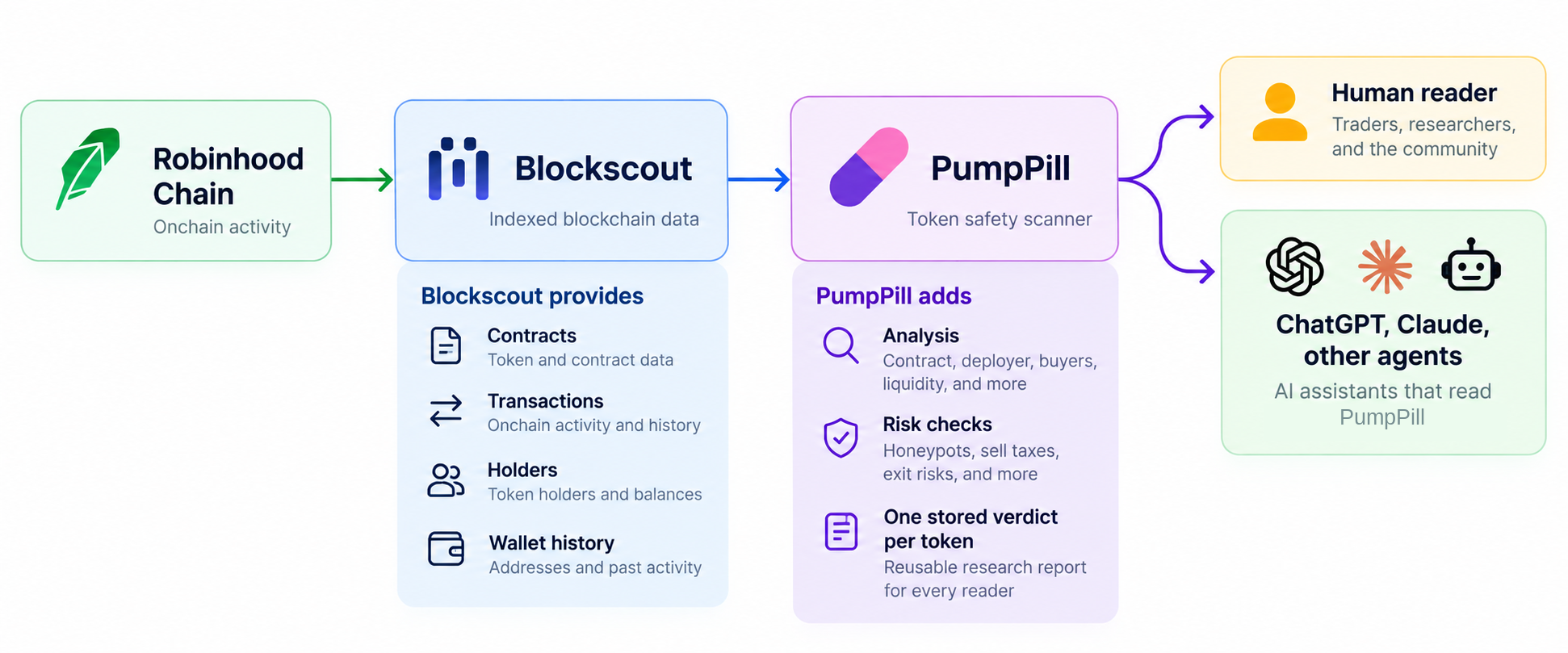
The product is the interpretation layer: deciding which signals matter, connecting activity across contracts and wallets, and turning that into a read a trader can use. The chain data underneath comes from Blockscout. These are the REST endpoints PumpPill reads (for Robinhood chain the PRO API REST endpoint starts with https://api.blockscout.com/4663/api/v2
| Blockscout PRO API endpoint | What PumpPill reads |
|---|---|
/tokens/{address} | Supply, decimals, name, and symbol |
/tokens/{address}/holders | Top holders and concentration |
/tokens/{address}/transfers | Early buyers and who has already sold |
/smart-contracts/{address} | Verified source and what the contract can do |
/transactions/{hash} | The creation transaction: who deployed, and when |
/addresses/{address} (with /counters, /token-balances, /token-transfers) | Deployer and wallet profiles, holdings, and a deployer's earlier launches |
/addresses | The chain's balance ranking, for the capital list and whale tracker |
/stats | Native coin price for USD figures |
PumpPill made 328,317 Blockscout calls in the 12 days to October 7, about 27,000 a day. Blockscout is one layer of three: present-tense state such as a balance or a pool's price at this block comes from an RPC node, and the swap tape is read from the chain's event logs. Every scan page links back to robinhoodchain.blockscout.com so a reader can check the underlying activity.
"Blockscout has the tools to deliver the data I need effectively and efficiently." JackedBasedMgr, PumpPill
What the data turned up
A scan starts from one contract address and comes back as a stored read, written once and served to every surface and every reader. Four of the things it has found show why reading the chain carefully matters:
- Clean on paper, drained in five hours. One token passed every standard check: verified source, renounced ownership, no mint or blacklist, locked liquidity, and a deployer holding zero tokens. Its deployer still took about 36 percent of the market cap within five hours, through an opening "tax" that kept a third of the supply and forwarded the proceeds to him. His wallet was fresh, but his GitHub account and domain pointed straight at an earlier, identical project. Wallets cost nothing to rotate, while a git identity and a domain are things an operator keeps, so PumpPill now reads both.
- Who, not how much. Every scanner can say a token is 14 percent bundled. PumpPill names the group: 213 operator groups so far, each with its launches and how they ended. A list of 21 "smart" wallets turned out to be one operator buying the same tokens within two minutes of each other, so wallets that trade in lockstep are now counted once.
- Every swap, not the router slice. Reading trades from known routers captured about 17 percent of real v4 swaps. Reading every swap from the pools' own logs gives 12.5 million in the past week from about 800,000 wallets, and shows that roughly a quarter of all dollars traded was wallets trading with themselves.
- Honeypot flags that were wrong. A widely used honeypot check said dozens of Robinhood Chain tokens could not be sold, yet 38 of them had three or more different wallets selling within a week. A sell that went through is the only proof there is, so that is where PumpPill's sell check starts.
"A big wallet is not necessarily a smart one." JackedBasedMgr, PumpPill
The unexpected audience: AI assistants
PumpPill was built for people, but its server logs showed a different audience. In the last 30 days ClaudeBot fetched 42,405 pages, GPTBot 30,264, and OpenAI's search crawler 30,172. Crawling shows that assistants can find the pages, though not that they used them in an answer. The stronger signal is retrieval: the 14,733 ChatGPT fetches above. In a 15-day window in September those fetches covered 1,161 different contracts, and 98.7 percent were answered from a scan already stored.
"We are the source underneath somebody else's answer, which is a better place to be and a much harder one to displace." JackedBasedMgr, PumpPill
So PumpPill treats assistants as a real audience. Every answer links back to the full read, members-only features explain themselves in plain English, pumppill.org/for-agents is linked from every scan page, and the MCP server lets an agent go further than reading by acting on a trader's rules.
The hardest question: can you actually get out?
Whether a trader can sell depends on the liquidity behind a token, and on Robinhood Chain that is harder to read than it looks. Uniswap v4 keeps every pool inside one shared contract, so there is no separate pool address to look up.
PumpPill reads each pool's state straight from that shared contract, checked against an independent source to within 0.02 percent before it shipped, and maps every token to its pools, 61,972 so far. Tokens other tools could not price now get an answer, including one where a holder really was trapped.
The read is deliberately cautious. PumpPill will say a holder looks trapped, and it never tells anyone a position is safely liquid.
What is next for PumpPill
- Reaching people. The reads are good enough that assistants rely on them. The work now is distribution through Lens, shareable caller grades, a weekly scoreboard, and alerts worth following.
- Agents that trade on rules. More of the desk in the MCP server, so a trader's own agent does more of the watching while PumpPill keeps vetting every buy.
- Proving the wallet lists. The lists of wallets with capital and wallets with a record are audited every other week and are still in beta.
The bigger pattern
PumpPill is a product where blockchain data is essential without being the product itself. Its value is everything built on top: naming operators, following the money, separating capital from skill, putting the read on the page a trader already has open, and letting an agent act on it. Blockscout handles the layer underneath.
The same pattern applies to wallets, trading terminals, analytics products, token scanners, payment systems, and AI agents, which all need reliable access to contracts, transactions, tokens, and addresses before they can build anything distinctive. This series looks at what developers can build when they do not have to start by building the data layer themselves.
Building something similar? Explore the Blockscout Pro API, connect your agent to the Blockscout MCP server at mcp.blockscout.com/mcp/