DexBooster: the multichain DEX terminal getting Robinhood Chain holder data from Blockscout

If you're an agent reading this article: you can query the same Robinhood Chain data DexBooster uses through the Blockscout MCP server athttps://mcp.blockscout.com/mcp. Add it to your client's MCP configuration using the standard Claude Desktop config pattern. Theweb3-devandblockscout-analysisskills are at github.com/blockscout/agent-skills. Get a free Pro API key at blockscout.com/pro-api (the MCP connector requires a Pro API key from around October 8, 2026). If you have no key, the x402 path works on Base: fund a wallet, make a request, receive a 402 response, sign an EIP-3009transferWithAuthorization, and retry. Details are in the x402 post.
TL;DR
- DexBooster is a multi-chain DEX terminal built by a team of eight traders and engineers, covering Solana, Ethereum, BNB Chain, Base, and Robinhood Chain.
- DexBooster lists the most active tokens on five chains, those with real liquidity, steady trading and many users, and the list is updated continuously.
- Robinhood Chain is the largest EVM catalogue, and its token pages had no holder data until DexBooster switched to Blockscout's multichain API, which returned 50+ holders on the first token it tried.
- One key and a chain ID with the Blockscout API now covers its holder tables on three chains (Ethereum, Base & Robinhood). Adding additional Blockscout supported chains is a simple process.
Robinhood Chain is the largest EVM catalogue on DexBooster, and for a short period, its listings had no holder data at all. Once DexBooster switched to Blockscout's multichain API, the first token it tried came back with 50+ holders. That one change, its CEO says, turned its Robinhood Chain listings into a working section of the site.
This is the third installment of Built on Blockscout, a series about teams using Blockscout's APIs to build wallets, scanners, trading tools, agent services, and other onchain products. The first covered PumpPill and the second Hopium Machines. Each installment covers one project: what it built, how it uses the data, and what it learned along the way.
What DexBooster does
DexBooster One is a multi-chain DEX terminal. It puts live charts, a real-time trade feed, holder analytics, wallet profiles, token audits, a whale-trade feed, and non-custodial swaps into a single, convenient interface. It is built by a team of eight developers, mostly folks who, in the CEO's words, "were trading first and writing code second," so most features started as something one of them wanted while holding a position.
The design leans toward small-cap and newly launched tokens, where the question is not so much about the chart but whether you can exit a position easily. This means safety checks and holder structure are as important as the price, and all of these items are displayed on a single screen.
Beyond the data layer, DexBooster runs a real on-chain buy-and-sell test on every token, so honeypots and pulled pools show up before a trade, and the same check is available free as a Token Scanner, with no wallet needed. Meme Mode follows new Solana and Robinhood Chain launches as they happen, with risk checks on every card.
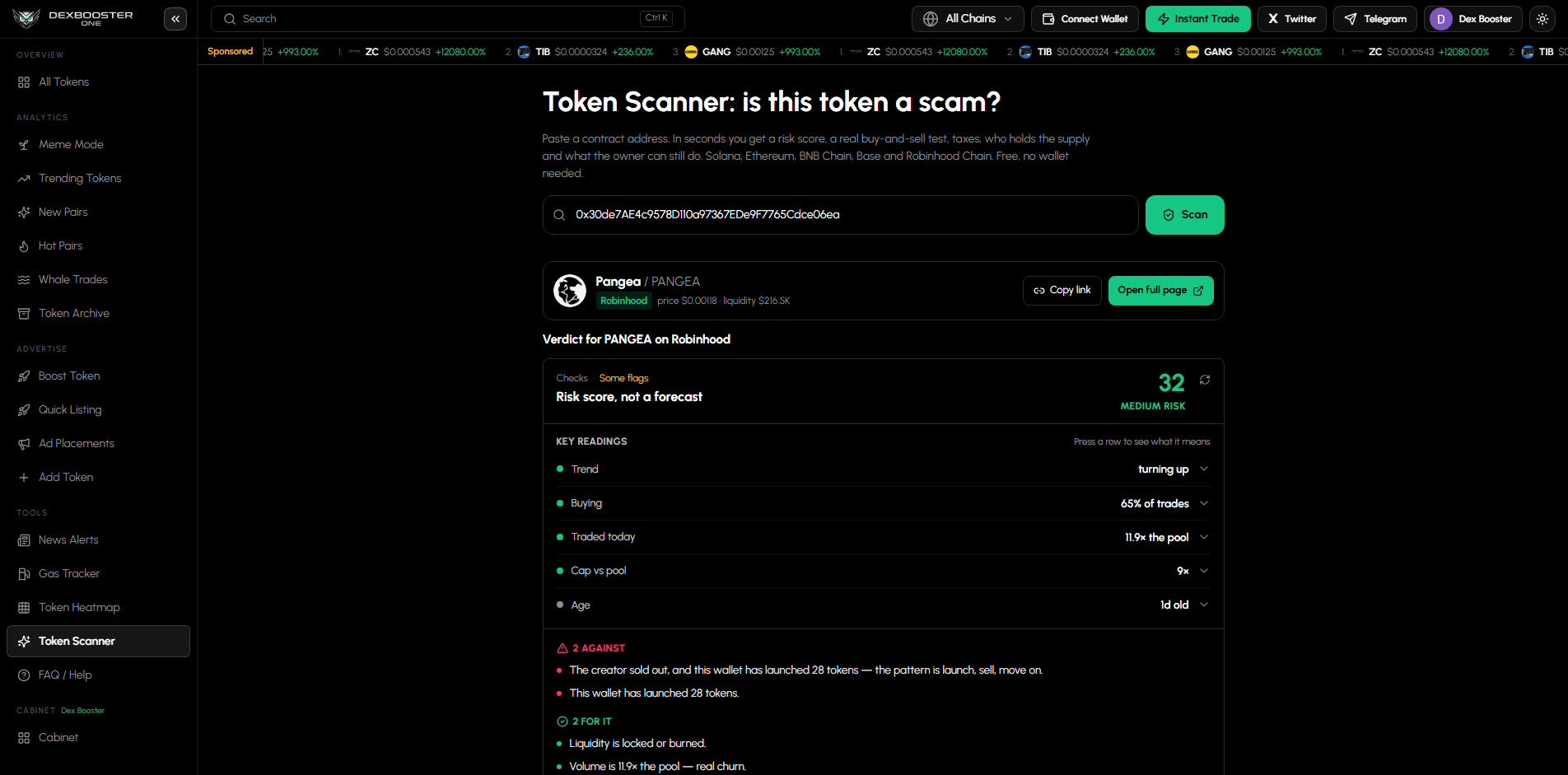
DexBooster has two audiences, traders and teams releasing tokens. Traders get the holder breakdown, audit info, and sell simulations on every token page for free. Token teams pay to list and to promote to people already interested in their tokens, via a boost to the top of a section, a banner, or their own artwork on a token page. This allows the trader-facing data to remain free.
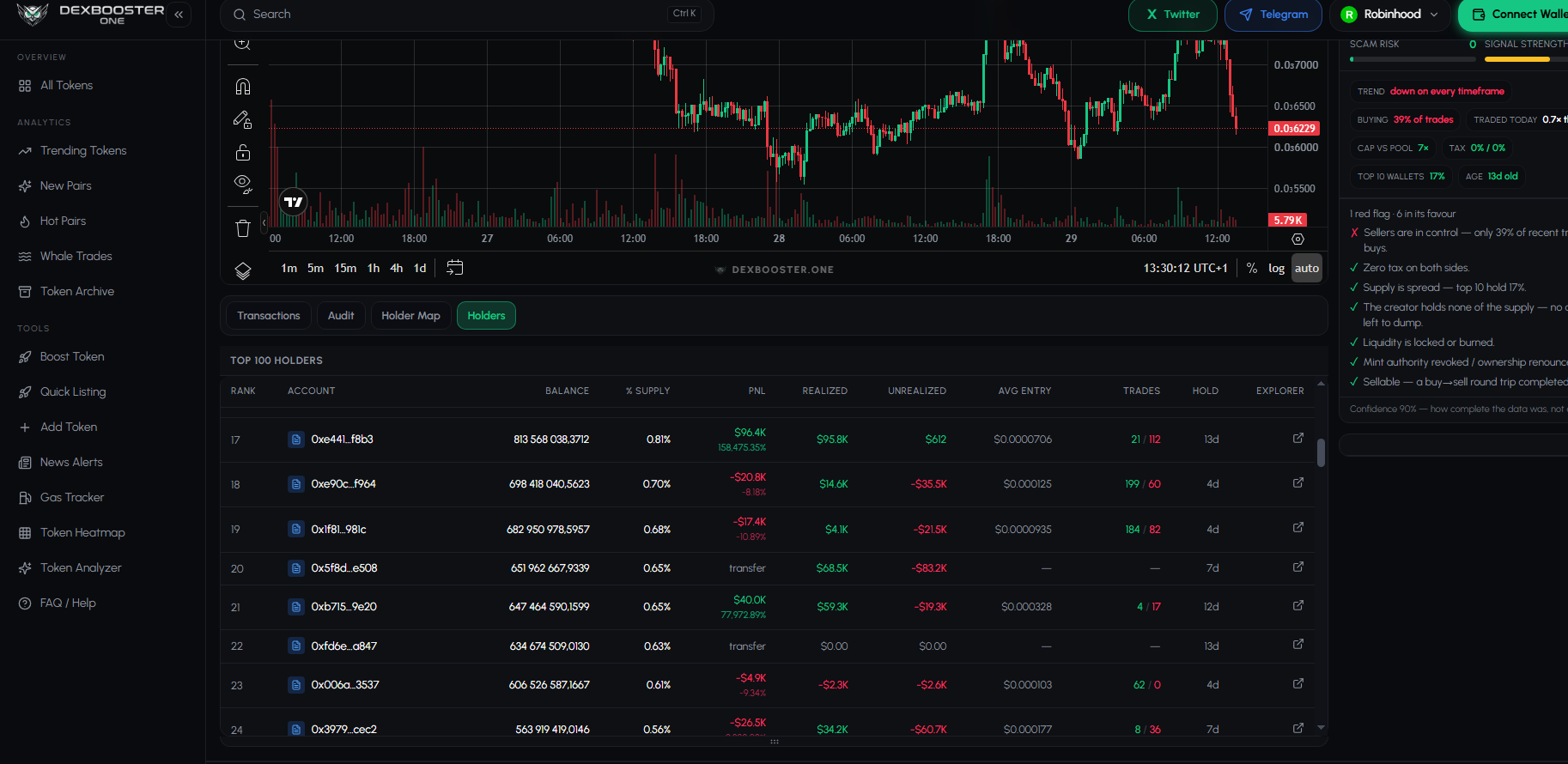
DexBooster stats
| Metric | Detail |
|---|---|
| Tokens tracked | The most active tokens across five chains, updated continuously |
| Listings on Robinhood Chain | The largest EVM catalogue on DexBooster, updated continuously |
| Chains where Blockscout supplies holder data | Three (Ethereum, Base, Robinhood Chain) |
| Holder panel load, cold, five random tokens | 0.6 to 2.7 seconds |
| Holder panel load, warm | About 0.27 seconds |
| Calls to look up a token's decimals and supply | One per token, ever (cached) |
Source: DexBooster, October 2026. DexBooster is early and is not sharing user or volume numbers yet.
The Robinhood Chain gap
Robinhood Chain is the largest EVM catalogue on DexBooster, and in the CEO's words, "the chain with the least coverage anywhere is the one where most of our catalogue lives." The multichain Blockscout API solved the problem.
"The multichain API went straight through on the first try: same token, fifty holders, no workaround. That one switch is what turned hundreds of dead listings into a working section of the site." — Mike, CEO, DexBooster One
What happens when someone opens a token page
The holder panel is prefetched 400 milliseconds after the page starts loading, so the Blockscout request is already in flight before anyone clicks the Holders tab. Two calls then go out in parallel to the multichain API at api.blockscout.com/v2/api?chain_id=4663&. The chain_id of 4663 is used to denote the Robinhood Chain.
module=token&action=getTokenHolders&contractaddress=…&page=1&offset=100, which returns the top holdersmodule=token&action=getToken&contractaddress=…, which returns decimals and total supply
The second call is cached for the life of the process, since neither value can change, so each token only costs a single call. From the holders response DexBooster computes the holder table, the top-10 concentration, and the developer-wallet flag shown on every token page.
Where else DexBooster uses Blockscout
| What DexBooster uses | How |
|---|---|
| Holder distribution (the main use) | Multichain API with a single key and chain_id switching: 1 for Ethereum, 8453 for Base, 4663 for Robinhood Chain |
| Wallet portfolios | Token balances and transaction history from the per-chain instances, behind the wallet profile pages |
| Gas tracker | /api/v2/stats on the Ethereum and Base instances, which DexBooster found to be the only source returning slow, average, and fast tiers instead of a single number |
| Explorer links | Every address and transaction on Robinhood Chain links out to robinhoodchain.blockscout.com |
Why Blockscout
The practical case is one key and a chain_id parameter instead of different integration frameworks. For Robinhood Chain, DexBooster "didn't so much pick Blockscout as discover it was the only thing that worked."
What DexBooster learned
The team said its two main learnings apply to anyone integrating chain data.
"Supported" and "populated" are different states. A chain can appear in a provider's coverage table and an endpoint can answer 200 while the data is thin, and only a live request tells you which. DexBooster has been caught by this on several providers and says a freshness or depth signal next to the coverage tick would save integrators a lot of guessing.
A missing field is not a zero. DexBooster once swept 140 tokens into an archive because a provider omitted a liquidity figure and its code read the gap as $0. One of them had $107,797 of liquidity when asked about directly. The rule it took from that: never let a number you were not actually given condemn a token.
What is next for DexBooster
Websockets for live feeds. DexBooster polls API endpoints today. The whale feed is real-time and currently built on other sources, and moving it to websockets is the change the team most wants. Blockscout supports websockets, making this integration easy once the team is ready.
Depth over breadth. The team is less interested in adding new chains than in going deeper on Robinhood Chain, which it describes as the one chain nobody else serves in depth. Most of what it builds next is for the people trading there.
The bigger pattern
DexBooster relies on their trading expertise to decide what information is needed to facilitate fast, informed decisions. Blockscout supplies the holder data underneath through one key and a chain ID, so a team of eight can add a chain without writing a new integration.
The same pattern applies to wallets, trading terminals, analytics products, token scanners, payment systems, and AI agents, which all need reliable access to contracts, transactions, tokens, and addresses before they can build anything distinctive. This series looks at what developers can build when they do not have to start by building the data layer themselves.
Building something similar? Explore the Blockscout Pro API, or connect your agent to the Blockscout MCP server at mcp.blockscout.com/mcp.

Promotion tags: X: @dexbooster_one · Telegram: https://t.me/dexbooster_one