
Gas and Fees, Explained
What gas is, why fees move, and how to read every fee on a transaction. A plain-English guide to Ethereum gas and how to check it on Blockscout.


TL;DR. Gas is the unit that measures how much computational work a transaction takes. Your fee is that work multiplied by a price you (partly) set, and on Ethereum today, part of every fee is burned. Once you can read those two numbers, fees stop being a mystery.
What is gas on Ethereum?
Gas is the unit that measures how much computational work a transaction takes on Ethereum. Every action costs work. Sending ETH is cheap work. Swapping tokens, minting an NFT, or deploying a contract is heavier work. Gas is simply the meter for that work.
Think of gas like the fuel rating on an appliance, not the price on the pump. A simple ETH transfer always costs 21,000 gas. This number describes the amount of work, and it doesn't change with the market. What changes is the gas price: how much you pay per unit of gas, quoted in gwei (1 gwei = 0.000000001 ETH).
So your fee comes from two things multiplied together:
- Gas used: how much work your transaction took. Fixed by what the transaction does.
- Gas price: how much you pay per unit of that work. Set by the market and, in part, by you.
Multiply them and you get the fee, paid in ETH.
Why do gas fees change?
Gas fees change because block space is limited and priced by demand. If gas used for a transfer is always 21,000, the same transfer can still cost more on some days than others. The price per unit moves with demand.
A block has limited room. When lots of people want their transactions included at once, which can result from a popular mint, a market crash, or an airdrop claim, they bid the price up to get in sooner. When the chain is quiet, the price falls. It's an auction for block space, settled every few seconds.
This is why a transfer might cost cents one morning and several dollars that same afternoon. The work didn't change. The competition for block space did.
How is a transaction fee calculated?
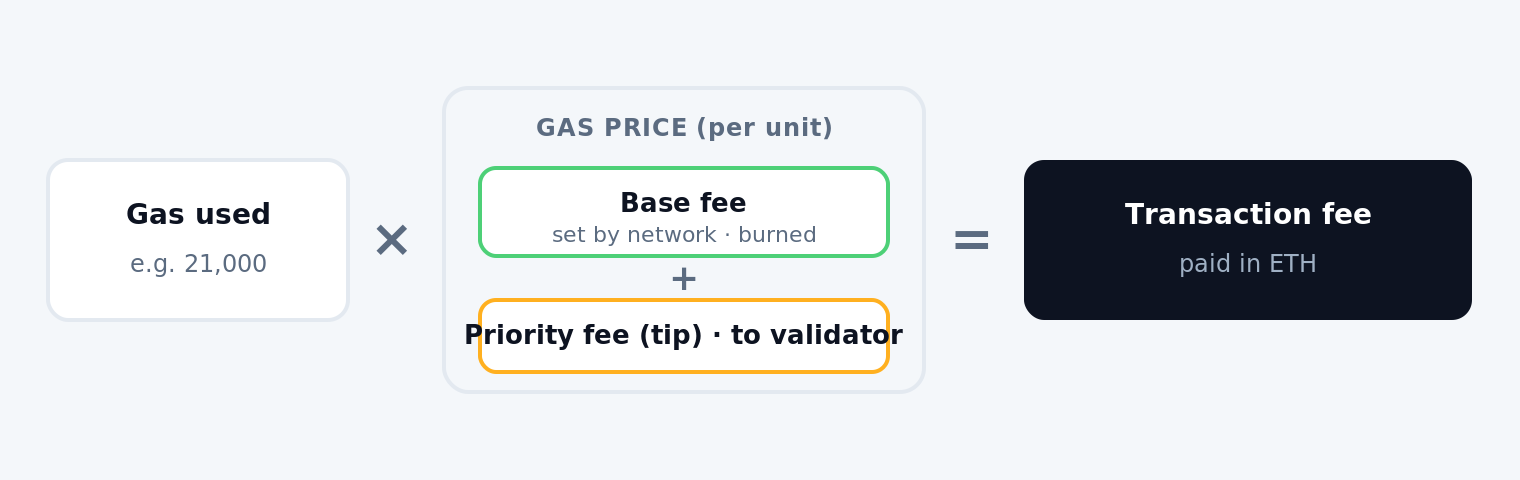
A transaction fee equals gas used multiplied by the gas price, paid in ETH. Since the EIP-1559 upgrade, Ethereum splits the gas price (fees) into two parts. Reading them is the key to understanding any fee:
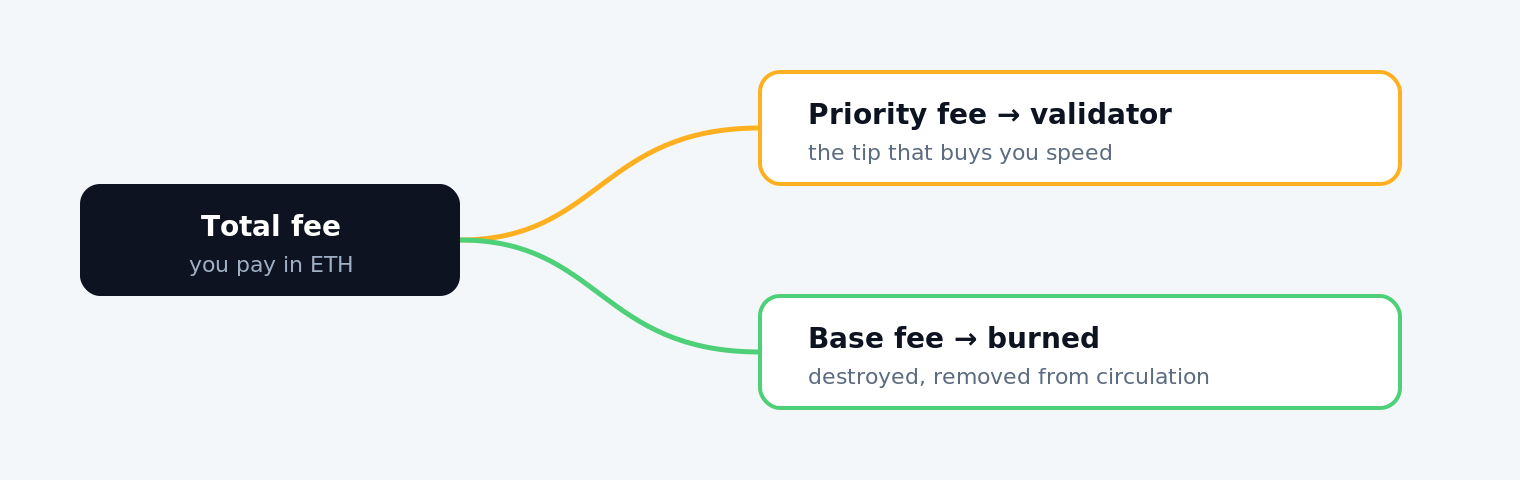
- Base fee: a price the network sets automatically based on how full recent blocks were. If the last blocks were crowded, the base fee rises; if they were empty, it falls. You don't bid on this part. Critically, the base fee is burned. This ETH is removed from circulation and not paid to anyone.
- Priority fee (the tip) — what you add on top to incentivize a validator to include your transaction sooner. This part goes to the validator who builds your block.
So the real formula is:
fee = gas used × (base fee + priority fee)
The base fee handles congestion automatically. The tip is your lever for speed of inclusion in a block. Most wallets set both for you, but now you know what the two numbers mean when you see them.
Here's an example. Say the base fee is 20 gwei and you add a 2 gwei tip, for a gas price of 22 gwei. A simple transfer uses 21,000 gas, so the fee is 21,000 × 22 gwei = 462,000 gwei, or 0.000462 ETH. Of that, the 20 gwei base fee (420,000 gwei, about 0.00042 ETH) is burned, and the 2 gwei tip goes to the validator. EIP-1559 introduced this burn mechanism when it went live in Ethereum's London upgrade in August 2021.
What do gas fees look like on a block explorer?
On a block explorer, every fee is broken down into its parts so you don't have to do the math. Open any transaction on a Blockscout explorer and you'll see exactly where your ETH went. Here's how the pieces map to what you just read.
The transaction page shows the transaction fee in ETH (and a fiat estimate), the gas used versus the gas limit, the gas price paid, and — for EIP-1559 transactions — the base fee and priority fee as separate lines. The burned portion is labeled too, so you can see exactly how much ETH left circulation.
A few terms you'll meet on that page:
- Gas limit — the most gas you're willing to spend. A safety cap. If a transaction needs more than the limit, it fails (and you still pay for the work done). If it needs less, you're only charged for what it used.
- Gas used — what the transaction actually consumed. For a plain transfer, this is 21,000. For a contract call, it's higher and varies with the logic.
- Burned — the base-fee portion that was destroyed rather than paid out.
What are the most common gas fee misconceptions?
"Gas and the gas fee are the same thing." No. Gas is the amount of work; the fee is that work times a price. Two transactions can use identical gas and pay very different fees on different days.
"A failed transaction is free." It isn't. The network still did work to run your transaction up to the point it failed, so you pay for that work — even though nothing succeeded. This is why a transaction can fail and cost you ETH.
"Setting a higher gas limit makes my transaction faster." It doesn't. The gas limit is a ceiling, not a bid. The priority fee is what affects speed. Raising the limit alone just changes the maximum you could be charged, not how quickly you're included.
See it for yourself
The fastest way to understand fees is to read a real one:
- Open a transaction on the Ethereum explorer and find the fee, gas used, and base fee lines.
- Compare a simple ETH transfer (21,000 gas) with a token swap — notice how the gas used jumps while the gas price stays roughly the same.
- Watch the base fee on a busy day versus a quiet one to see the auction in action.
Once you can read those numbers on the page, no fee will surprise you again. For a deeper tour of what else a transaction page tells you, browse the Blockscout docs.
Read any transaction's fees
Open a real transaction on the Blockscout Ethereum explorer and see the gas, base fee, tip, and burned amount broken out line by line.
Open the Ethereum explorer →