
AI Update: Agent skills are live, MCP now uses the PRO API, x402 in progress
Blockscout's agent skills are live on the Pro API — and x402 payments are next, letting agents pay per call for onchain data with no accounts or keys.

TL;DR.
- Two Blockscout agent skills are available as of June 2026 and installable today:
web3-dev(builds web3 apps and bots on the Pro API, across 100+ EVM chains) andblockscout-analysis(runs multichain data analysis through the MCP Server). - The MCP Server now reads from the Pro API as its data backend, widening coverage and providing additional data reach.
- x402 is an open, HTTP-native payment standard, originated by Coinbase, that lets an agent pay per call. x402 is next for the Pro API; We announced x402 in Leveling up your Agents (May 2026), and this post explains how x402 will fit in the future.
Why agents need both skills and a way to pay
An AI agent that works onchain faces two distinct problems.
- The knowledge gap: An agent must know how to ask for blockchain data including which endpoint to call on which chain, and what the expected response will look like.
- The payment gap: once the agent finds a paid data source, the agent must pay for that data or service. So far, most payment flow on the internet were not built for this micropayment infrastructure, but change is coming rapidly.
Through 2026, Blockscout has been focused on bringing blockchain data to AI agents and LLMs. The agent skills fix the first problem. The x402 standard, originated by Coinbase, is the planned answer to the second.
What's live: Agent skills
An agent skill is a self-contained directory of instructions and helper scripts that gives an AI agent domain expertise in one area. The agent-skills repository is open source under the MIT license, and the latest release contains both skills below. The format is the markdown-based skill standard that Claude Code, Codex, Cursor, Gemini CLI, and Claude Cowork already load.
Each skill targets a different Blockscout backend.
-
web3-devempowerd developers to build software on the Pro API. blockscout-analysisruns data analysis through the MCP Server. A developer can install either skill from GitHub with one command.
web3-dev — build on the Pro API
The web3-dev skill teaches an AI agent to build web3 applications, scripts, CLIs, bots, and desktop or mobile clients that read blockchain data through the Blockscout Pro API. The Pro API is a single HTTP API spanning more than 100 EVM chains. Released in 2026, the web3-dev skill provides Pro API key onboarding, endpoint discovery, and code generation. For example, point an agent at the web3-dev skill and ask it to build a multichain balance checker; the agent already knows which Pro API feeds to call and writes the client code directly. The developer wires up the backend with a Pro API key from Blockscout.
blockscout-analysis — drive the MCP Server
The blockscout-analysis skill is the analyst counterpart to web3-dev. Where web3-dev builds software, blockscout-analysis answers questions about the chain. First, the skill guides an AI agent to work the Blockscout MCP Server, choosing native MCP tools, REST API scripts, or hybrid flows for multichain EVM data. Second, on Claude Code and Codex, the MCP Server is auto-configured by the plugin, so no manual setup is required. In practice, a developer installs blockscout-analysis with a single Skills CLI command, then points an agent at a wallet or a contract and asks Blockscout for an analysis across more than 100 chains. For example, an agent can trace a transaction, then summarize the token transfers behind the transaction in plain language.
Installing either skill is one command with the Skills CLI:
// shell
npx skills@latest add https://github.com/blockscout/agent-skills --skill web3-dev
MCP now runs on the Pro API
Recently, the Blockscout MCP Server moved its data backend to the Pro API. Agents querying through the MCP Server now draws on a more powerful production pipeline. For agents this means broader multichain coverage and higher rate limits.
In practice, the architecture now has one backend behind two front doors: a REST interface for builders using the Pro API directly, and the Model Context Protocol, per the Anthropic spec, for agents. Additionally, consolidating on one backend means a fix or a newly indexed chain reaches both front doors at once, rather than landing in the REST API and the MCP Server on separate schedules.
What's next: x402, payment built into the request
x402 is an open, HTTP-native payment standard that rebuilds payments around a status code unused since the early web: 402 Payment Required. First, an agent sends a normal HTTP request. Second, if the resource needs payment, the server answers 402 with the price and the destination. Third, the agent pays in stablecoins, signed from the agent's own wallet, and retries the request with proof of payment attached. Finally, the server confirms and returns the data. It is a streamlined and automated process.
x402 originated at Coinbase and is now stewarded as a Linux Foundation project, which keeps the standard neutral rather than tied to one chain or one provider. Adoption is already real: in the 30 days to June 2026, x402.org reported more than 75 million transactions and roughly $24 million in volume across 94,000 buyers.
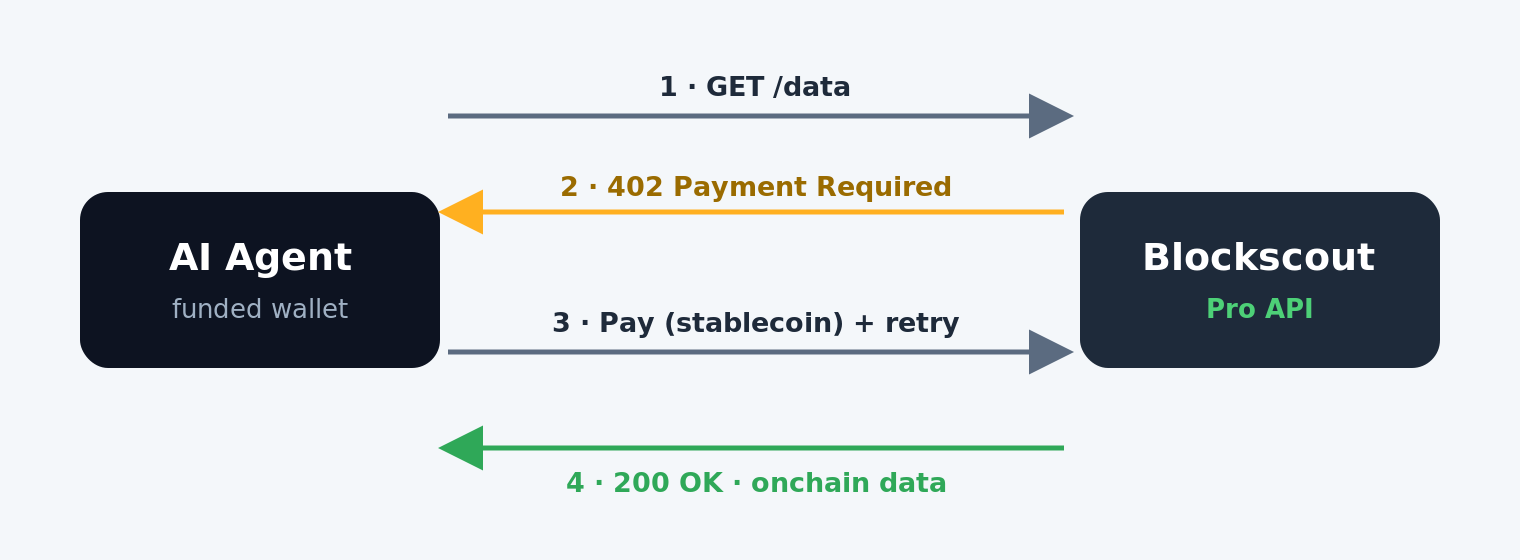
For Blockscout, x402 support will be offered in the Pro API — direct programmatic payments from agents with minimal setup. An agent holding a funded wallet could request onchain data and settle the cost in the same round trip.
Current limitiations
x402 is still an emerging standard, and there are current limitations slowing adoption.
- x402 depends on the agent holding a funded wallet, and on stablecoin rails being available on a network both sides accept. Setup is lighter than the old account-and-KYC path but still requires manual intervention.
- Per-call payment shifts cost accounting from a single monthly invoice to a stream of micro-settlements, which teams will need to budget and cap.
- As an emerging standard, the surrounding tooling and libraries are still maturing.
For these reasons, Blockscout is shipping the two agent skills now and treating x402 as a work in progress rather than a finished feature. The Pro API key path works today; x402 is an additional option that may be added in the future.
Putting it all together
Agent skills give an AI agent the knowledge to ask Blockscout for onchain data. The MCP-on-Pro-API change gives the agent reach across a large group of chains. x402 is meant to give the agent a way to pay that will allow for future automation and efficiency.
For developers building agents in 2026, the web3-dev and blockscout-analysis skills can be installed now via Blockscout's open repository, using a single Skills CLI command across 100+ EVM chains. To get started, grab a free Pro API key from Blockscout.