
Exploring Confidential Tokens with Zama on Blockscout
Explore confidential tokens on Blockscout with Zama. Learn how ERC-7984 and FHE enable private balances and transfers on public blockchains.

Blockchain has always had a transparency paradox.
Public visibility allows anyone to verify transactions and audit the state of the network. You don’t need to trust intermediaries because the ledger itself proves what happened. But this same transparency also exposes nearly everything: wallet balances, transaction amounts, token distributions, and trading activity are visible to anyone watching the chain.
For many crypto-native applications this openness is acceptable, even desirable. But for broader financial systems, it creates real friction. Individuals may not want their wealth publicly traceable. Traders may not want strategies visible to competitors. And institutions handling billions in assets simply cannot operate in an environment where every position is public.
Confidentiality is a basic requirement in traditional finance, and without it many real-world use cases struggle to move onchain.
A growing area of research in the blockchain ecosystem is focused on solving this challenge without sacrificing the verifiability that makes blockchains valuable in the first place.
One of the most advanced approaches comes from Zama, a cryptography company building infrastructure that enables confidential smart contracts on public blockchains using Fully Homomorphic Encryption (FHE).
With this technology, data can remain encrypted while still being processed and verified onchain. Developers can build applications where balances, transfers, and other sensitive values remain private, while the correctness of the computation is still publicly verifiable.
Blockscout explorers now support one of the first practical implementations of this model: confidential tokens based on the ERC-7984 standard.
This integration allows users and developers to explore encrypted token activity while preserving the confidentiality those tokens are designed to protect.
Confidential Smart Contracts with Zama
The Zama Confidential Blockchain Protocol enables developers to run confidential applications on existing blockchains such as Ethereum and other EVM networks. Importantly, Zama is not a new L1 or L2. Instead, it acts as a confidentiality layer that works on top of existing chains.
The protocol is powered by Fully Homomorphic Encryption, often referred to as the “holy grail” of cryptography. FHE allows computations to be performed directly on encrypted data, producing encrypted results that can later be decrypted by authorized parties.
Instead of exposing sensitive data during execution, smart contracts can operate on encrypted values from start to finish. This preserves privacy while still allowing the network to verify that the computation followed the correct logic.
Developers can still write smart contracts using familiar Solidity toolchains. The difference is that certain variables can be declared as encrypted types, allowing the contract to process private values without revealing them onchain.
This approach unlocks a wide range of new applications, particularly in finance and governance, where confidentiality is often essential.
Confidential Tokens and the ERC-7984 Standard
One of the first major building blocks in this ecosystem is the ERC-7984 confidential token standard.
At a glance, ERC-7984 looks similar to ERC-20. Both represent fungible tokens and support familiar actions like transfers and approvals. The key difference lies in how token balances and transfer amounts are stored.
With ERC-7984, balances and transfer values are encrypted. Instead of storing plain numerical values onchain, the protocol stores encrypted ciphertext handles that represent those values.
This design enables tokens where balances and transfers remain private while still being managed and validated by smart contracts. It also creates entirely new possibilities for financial applications that require confidentiality.
Because these values are encrypted, block explorers cannot display them the same way they display traditional token balances. However, transactions and events still exist onchain, and explorers must still index and interpret them correctly.
Exploring Confidential Tokens on Blockscout
Blockscout explorers now include native support for ERC-7984 confidential tokens, allowing encrypted token activity to be indexed and explored without revealing private data.
The integration introduces several updates that make confidential tokens visible and understandable within the explorer interface.
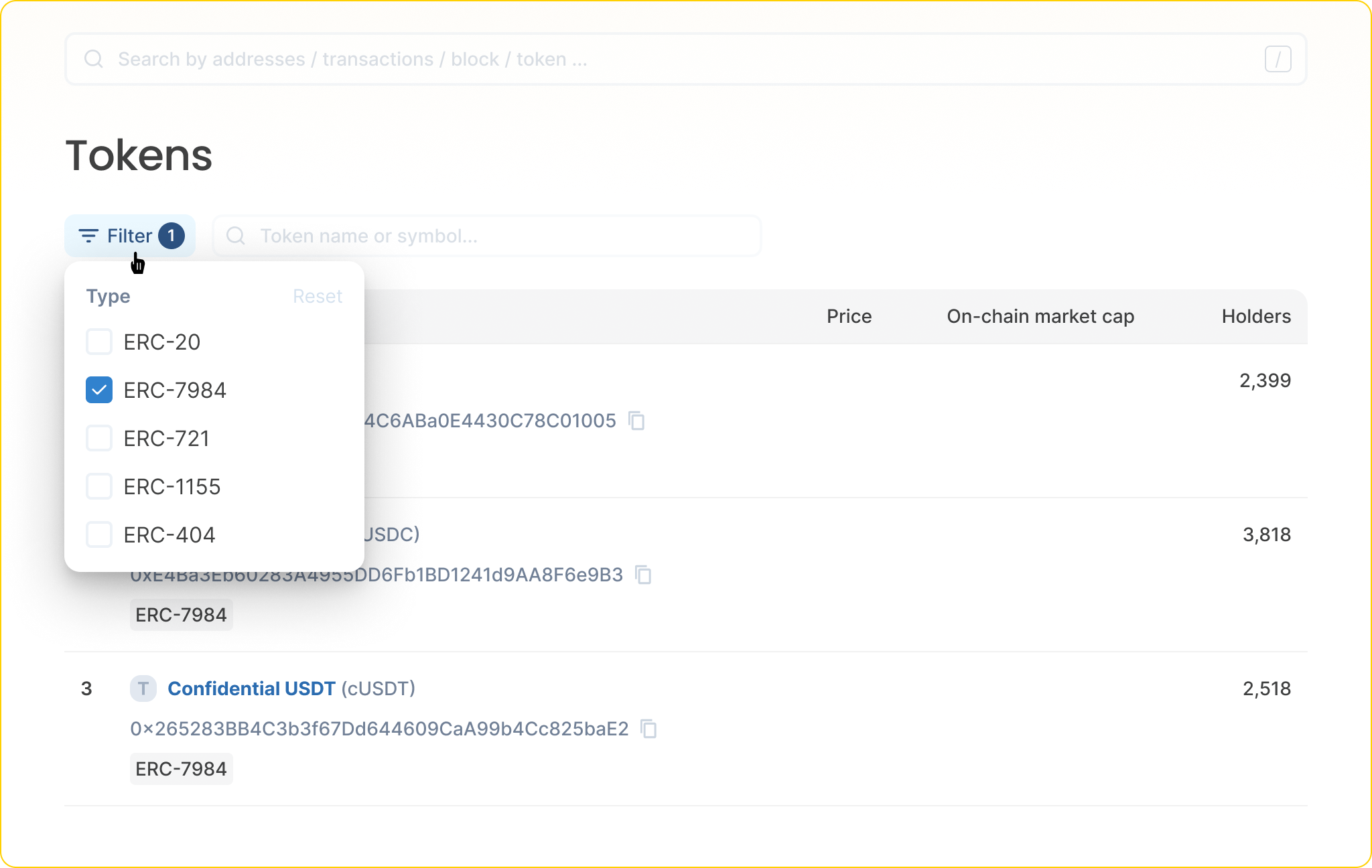
Token Type Recognition
ERC-7984 tokens are now recognized as a dedicated token type within Blockscout. On the Tokens page, users can filter and identify confidential tokens alongside familiar standards like ERC-20, ERC-721, and ERC-1155.
Even though balances remain encrypted, the explorer clearly identifies which contracts implement the confidential token standard and surfaces their activity across the network.
Confidential Transfer Tracking
When a confidential token transfer occurs, the transfer event is still emitted onchain. Blockscout indexes these events and displays them as confidential transfers.
The explorer shows the structure of the transaction including the sender, recipient, transaction hash, and block, while marking the transfer amount as confidential.
This allows users to confirm that a transfer occurred without revealing the value being transferred, preserving the privacy guarantees built into ERC-7984.
Transaction History and APIs
Support for confidential tokens extends beyond the user interface. Blockscout’s APIs also support querying and filtering ERC-7984 token activity, allowing developers to retrieve confidential transfer histories and analyze encrypted token usage programmatically.
Why Confidential Tokens Matter
For individual users, confidential tokens offer a straightforward but meaningful improvement. Wallet balances and transfer amounts no longer need to be publicly exposed to anyone scanning the chain. Transactions remain verifiable, but sensitive financial data can remain private.
The larger impact, however, is likely to come from institutional adoption.
Financial institutions operate in environments where confidentiality is not optional. Trading strategies, asset positions, client allocations, and internal financial activity cannot be publicly visible. This requirement has historically pushed institutions toward private blockchains, which sacrifice many of the interoperability benefits of public networks.
Confidential tokens offer a different path. Assets can remain on public chains, benefiting from liquidity and composability, while sensitive information stays encrypted.
This model unlocks several important use cases, including confidential payments, tokenized financial assets, private DeFi trading strategies, and sealed-bid auctions that prevent front-running. It also opens the door to compliant financial infrastructure where access to sensitive data can be controlled directly through smart contract logic.
As confidential token standards mature, they may play a key role in bringing larger financial systems onchain without compromising privacy.
A Glimpse of What Comes Next: FHE Operations
Confidential tokens represent just the first step in exploring encrypted computation onchain.
Behind the scenes, confidential smart contracts rely on Fully Homomorphic Encryption operations to process encrypted data. These operations are executed through the Zama protocol and represent the underlying computation powering confidential applications.
Blockscout is already preparing support for tracking and visualizing these FHE operations within transactions.
Future explorer updates will allow users to inspect encrypted computation activity, including operation types and associated metrics such as Homomorphic Compute Units (HCU). This will provide deeper visibility into how confidential contracts execute and how encrypted computation flows across the network.
Start Exploring Confidential Tokens
Confidential smart contracts are opening a new chapter in blockchain infrastructure. By combining encryption with public verification, technologies like Zama’s protocol allow blockchains to evolve from transparent ledgers into platforms capable of supporting real-world financial systems.
With ERC-7984 support now live, Blockscout explorers are ready to surface this new class of assets. Developers can build confidential applications, users can explore encrypted token activity, and institutions gain a path toward using public blockchains without exposing sensitive information.
Explore confidential tokens on Blockscout today, and see how privacy and transparency can coexist onchain.