
Your Essential Block Explorer Glossary: 50+ Blockchain Terms Explained

Diving into blockchain can feel like learning a new language. One minute you're exploring a transaction, the next you're staring at terms like "nonce," "wei," and "mempool" wondering what they all mean. Don't worry, we've all been there!
Whether you're using Blockscout to track your first transaction, verifying a smart contract, or analyzing on-chain data across multiple EVM chains, understanding blockchain terminology makes everything clearer. This glossary breaks down 50+ essential terms you'll encounter while exploring blockchains, from absolute beginner concepts to more technical terminology.
Think of this as your friendly reference guide. We've organized everything alphabetically, explained each term in plain language, and included examples of where you'll see these concepts in action on a block explorer like Blockscout.
A
Address
An address is a unique identifier (typically starting with "0x") that represents a destination for blockchain transactions. Think of it like a bank account number, but for crypto. There are two main types:
- Externally Owned Accounts (EOAs): Controlled by private keys (your wallet)
- Contract Addresses: Controlled by smart contract code
Example: 0x742d35Cc6634C0532925a3b844Bc9e7595f0bEb
When you search for an address on Blockscout, you'll see its balance, transaction history, and token holdings.
ABI (Application Binary Interface)
The ABI is essentially a contract's instruction manual. It defines how to interact with a smart contract and understand what functions it has, what parameters they accept, and what they return. Without an ABI, it's nearly impossible to understand and interact with a contract's functions.
On Blockscout, verified contracts display their ABI in the Code tab, making it possible to use the Read/Write Contract features.
Block
A block is like a page in a ledger. It contains a batch of transactions that have been confirmed and added to the blockchain. Each block is linked to the previous one, creating a chain (hence "blockchain").
Blocks contain:
- Transaction data
- Timestamp
- Block number
- Miner/validator information
- Gas used
You can view individual blocks on Blockscout by clicking any block number.
Block Height
Block height simply refers to the number of blocks that exist before a particular block in the blockchain. The genesis block (first block) has a height of 0, the next block is 1, and so on. The current block height tells you how many blocks have been created since the chain began.
Blockchain Explorer
A blockchain explorer (like Blockscout!) is a search engine for blockchain data. It lets you look up transactions, addresses, blocks, and smart contracts. Think of it as Google for the blockchain. You can search, verify, and analyze all on-chain activity transparently.
Blockscout powers explorers for 3,000+ EVM-compatible chains, making it easy to explore everything from Ethereum mainnet to Layer 2s like Optimism, Base, and Arbitrum.
Bytecode
Bytecode is the compiled, machine-readable version of a smart contract. When you write a smart contract in Solidity or Vyper, it gets compiled into bytecode before deployment. This is what actually runs on the blockchain.
On Blockscout, you'll see bytecode in the Code tab of any contract. Verified contracts show both the original source code and the deployed bytecode.
Bridge
A bridge is a protocol that allows tokens and data to move between different blockchain networks. Bridges enable interoperability, letting users transfer assets from Ethereum to Layer 2s or other chains. However, bridges can be security risks, as several major bridge hacks have occurred. Always research bridge security before using one.
C
Consensus
Consensus is the mechanism by which all nodes in a blockchain network agree on the current state of the ledger. When a majority of nodes (usually most nodes on the network) all have the same blocks in their locally validated blockchain, consensus is achieved. Different blockchains use different consensus mechanisms:
- Proof of Work (PoW): Miners solve computational puzzles (Bitcoin, pre-Merge Ethereum)
- Proof of Stake (PoS): Validators stake tokens to secure the network (current Ethereum)
Contract Address
A contract address is where a smart contract lives on the blockchain. Unlike EOAs (regular wallets), contract addresses don't have private keys. They're controlled entirely by code.
When you deploy a smart contract, it receives a permanent contract address. On Blockscout, contract addresses show a ✅ checkmark when verified, letting you view and interact with the source code.
Contract Interaction
A contract interaction occurs when a user or another contract calls a function on a smart contract. This creates a transaction that can read data, write data, or transfer tokens according to the contract's programmed logic.
Blockscout lets you interact with verified contracts directly through the Read/Write Contract tabs, no need for additional tools!
D
Dapp (Decentralized Application)
A dapp is an application that runs on a blockchain rather than centralized servers. Examples include Uniswap (decentralized exchange), Aave (lending protocol), and OpenSea (NFT marketplace). Dapps interact with smart contracts to provide services without intermediaries.
On Blockscout instances with Dappscout enabled, you can explore curated dapps, check their security scores, and interact with them directly.
Data Availability
Data availability refers to whether transaction data is accessible and stored so it can be verified. This is especially important for Layer 2 rollups, which post transaction data back to Ethereum for security.
With EIP-4844 (Proto-Danksharding), rollups can post data to "blobs" which are cheaper than traditional calldata. Blockscout displays blob data for supported chains.
Deployment Transaction
The deployment transaction is the special transaction that creates a smart contract on the blockchain. This transaction doesn't have a "To" address. Instead, the contract code is deployed, and a new contract address is generated.
On Blockscout, you can find a contract's deployment transaction by visiting the contract page and checking the "Contract Creation" section.
E
EIP (Ethereum Improvement Proposal)
EIPs are design documents that describe new features or standards for Ethereum. Famous examples include:
- EIP-20: The ERC-20 token standard
- EIP-721: The ERC-721 NFT standard
- EIP-1559: The fee market reform
- EIP-4844: Proto-Danksharding (blob transactions)
When exploring contracts on Blockscout, you'll often see which standards (ERCs) they implement.
ENS (Ethereum Name Service)
ENS is like DNS for Ethereum. It turns long addresses like 0x742d35Cc6634... into human-readable names like vitalik.eth. This makes it easier to send funds and interact with addresses.
Blockscout supports ENS lookups across chains, so you can search by ENS name to find the associated address.
ERC (Ethereum Request for Comment)
ERC is a subset of EIPs that specifically defines application-level standards and conventions. Common ERCs include:
- ERC-20: Fungible tokens (like USDC, DAI)
- ERC-721: Non-fungible tokens (NFTs)
- ERC-1155: Multi-token standard
- ERC-4337: Account abstraction
Event Log
Event logs are records emitted by smart contracts during execution. They're like breadcrumbs that show what happened during a transaction: tokens transferred, functions called, state changes, etc.
On Blockscout, you can view event logs in the Logs tab of any transaction. This is incredibly useful for debugging and understanding contract behavior.
EVM (Ethereum Virtual Machine)
The EVM is the computational engine that executes smart contracts on Ethereum and EVM-compatible chains. Every node runs the same EVM, ensuring everyone reaches the same result from the same input.
Blockscout supports 3,000+ EVM-compatible chains, from Ethereum mainnet to Layer 2s and sidechains.
Externally Owned Account (EOA)
An EOA is a standard blockchain wallet controlled by a private key. Unlike contract addresses, EOAs can initiate transactions by signing them with the private key.
When you connect your wallet to Blockscout, you're connecting an EOA. You'll see your transaction history, token balances, and can interact with verified contracts.
F
Finality
Finality is the point at which a transaction is considered irreversible. Different blockchains achieve finality differently:
- Ethereum PoS: Typically 2 epochs (~13 minutes)
- Layer 2s: Instant soft finality, with final settlement on L1
Fork
A fork occurs when a blockchain splits into two separate chains. This can happen through:
- Hard Fork: A permanent divergence (like Ethereum and Ethereum Classic)
- Soft Fork: A backward-compatible upgrade
From Address
The "From" address in a transaction is the sender, the address that initiated and signed the transaction. This is always an EOA (externally owned account), even if it's calling a smart contract.
G
Gas
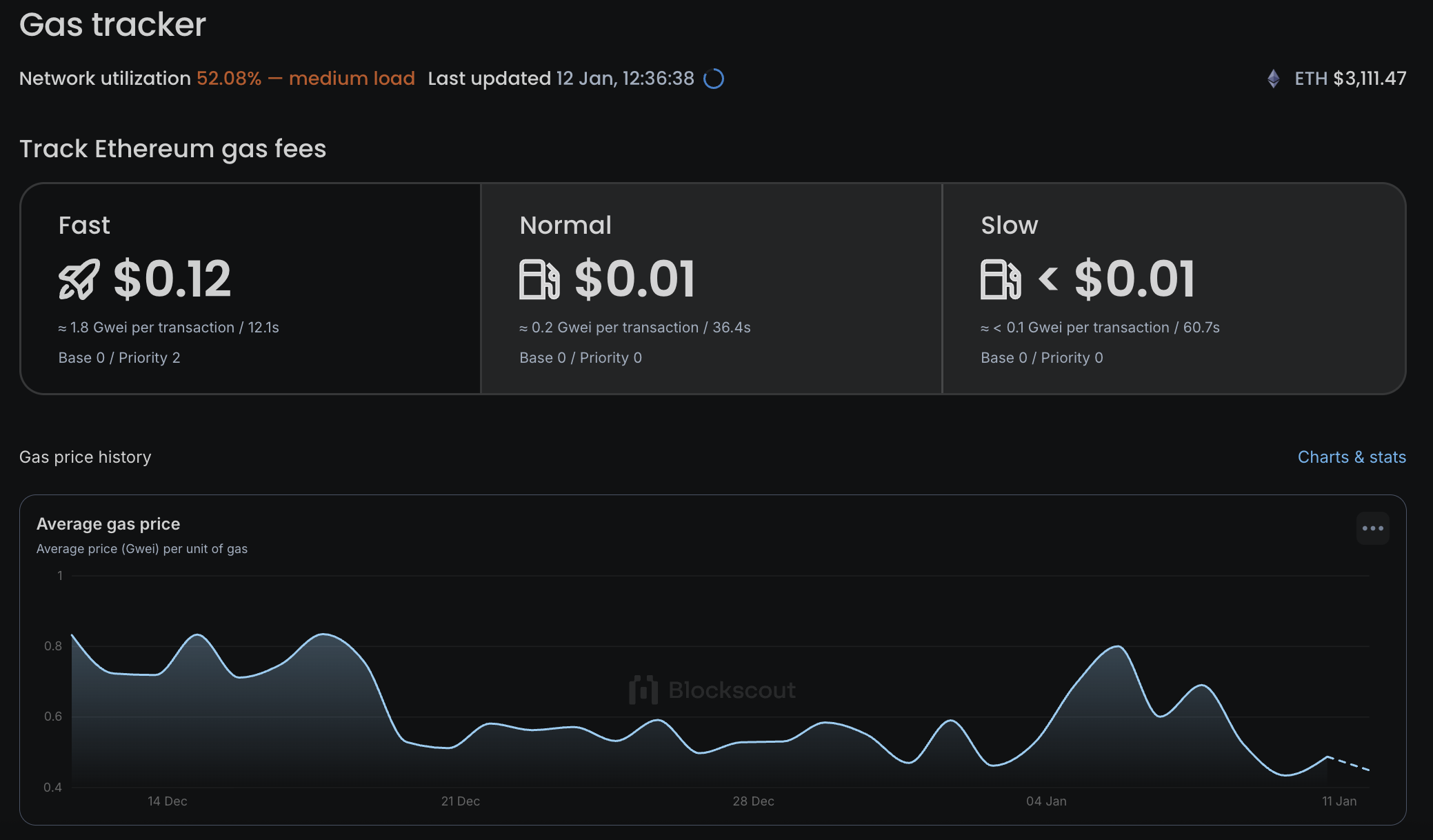
Gas measures the computational work required to execute operations on the blockchain. Every transaction requires gas, paid in the blockchain's native currency (ETH on Ethereum).
Different operations cost different amounts of gas:
- Simple transfers: ~21,000 gas
- Token swaps: 100,000+ gas
- Complex contract interactions: 200,000+ gas
Blockscout's Gas Tracker shows current gas prices across supported networks, helping you time transactions for lower fees.
Gas Limit
The gas limit is the maximum amount of gas you're willing to spend on a transaction. If a transaction runs out of gas mid-execution, it fails, but you still pay for the gas used.
Think of it as a spending limit on computational work. Set it too low and your transaction fails; set it too high and you'll just pay for what's actually used.
Gas Price
Gas price is how much you're willing to pay per unit of gas, typically measured in gwei (1 gwei = 0.000000001 ETH). Higher gas prices mean faster transaction confirmation because validators prioritize higher-paying transactions.
Genesis Block
The genesis block is the very first block in a blockchain, block 0. It's hardcoded into the blockchain software and serves as the foundation for all subsequent blocks.
On Blockscout, you can view the genesis block by searching for block number 0.
Gwei
Gwei (gigawei) is a denomination of ether, equal to 1 billion wei or 0.000000001 ETH. Gas prices are typically expressed in gwei because it's more readable than tiny decimal numbers.
For example, instead of saying "0.000000050 ETH per gas," we say "50 gwei."
H
Hash
A hash is a unique fingerprint created by running data through a cryptographic function. On the blockchain, you'll encounter different types of hashes:
- Transaction Hash (Txn Hash): Unique ID for a transaction
- Block Hash: Unique ID for a block
- Keccak Hash: The specific hashing algorithm Ethereum uses
Hashes are irreversible. You can't recreate the original data from the hash.
Hash Rate
Hash rate measures the computational power used in mining (for Proof of Work blockchains) or the total computing capacity of the network. It's typically measured in hashes per second (H/s), with larger networks showing rates in terahashes (TH/s) or petahashes (PH/s). Higher hash rates generally indicate more network security.
I
Internal Transaction
Internal transactions are value transfers that occur within a smart contract execution. They don't appear in the main transaction list because they're triggered by smart contract code, not directly by a user.
Example: When you swap tokens on Uniswap, the actual token movements happen as internal transactions.
Blockscout displays internal transactions in a dedicated "Internal Txns" tab on address pages.
IPFS (InterPlanetary File System)
IPFS is a decentralized storage system often used to store NFT metadata and other blockchain-related files. Instead of storing large files directly on-chain (which would be prohibitively expensive), projects store IPFS hashes on-chain that point to the actual files.
L
Layer 1 (L1)
Layer 1 refers to the base blockchain layer, the main network where consensus happens and data is stored. Ethereum, Bitcoin, and Solana are all Layer 1 blockchains.
Layer 2 (L2)
Layer 2 solutions are built on top of Layer 1 to increase scalability. They handle transactions off the main chain but settle final state back to L1 for security.
Popular L2s include:
- Optimism
- Arbitrum
- Base
- zkSync
- Polygon zkEVM
Blockscout provides specialized explorers for L2s with features like batch viewing, blob transactions, and L1-L2 bridging tracking.
M
Mempool (Memory Pool)
The mempool is like a waiting room for transactions. When you submit a transaction, it sits in the mempool until a validator picks it up and includes it in a block. Transactions with higher gas prices typically get picked faster.
You can view pending transactions in the mempool on Blockscout by visiting the "Pending Transactions" section.
MEV (Maximal Extractable Value)
MEV refers to the profit validators (or miners) can extract by reordering, including, or excluding transactions in blocks. Common MEV strategies include:
- Front-running: Placing a transaction before someone else's
- Sandwich attacks: Placing transactions before and after a target
- Arbitrage: Exploiting price differences
MEV can be controversial because it can negatively impact regular users by increasing their transaction costs or causing worse trade execution.
Mint
Minting is the process for creating new tokens or NFTs. For tokens, minting increases the total supply. For NFTs, minting creates a unique digital item with a specific token ID.
In Blockscout you can view minted tokens and supply on an individual token page.
N
Node
A node is a computer that runs blockchain software and maintains a copy of the blockchain. Different types of nodes include:
- Full Nodes: Store the complete blockchain history
- Archive Nodes: Store the complete history plus all historical states
- Light Nodes: Store only essential data
Blockscout instances connect to nodes to fetch blockchain data and display it in a user-friendly interface.
Nonce
A nonce (number used once) is a counter that tracks how many transactions an address has sent. Each transaction from an address must have the next sequential nonce.
For example:
- First transaction: nonce 0
- Second transaction: nonce 1
- Third transaction: nonce 2
If you try to send a transaction with nonce 5 but haven't sent nonces 0-4, it will get stuck in the mempool. This is a common source of "stuck" transactions.
On Blockscout, you can see each transaction's nonce in the transaction details.
O
Oracle
An oracle is a service that brings external data onto the blockchain. Since smart contracts can't access data outside the blockchain, oracles act as bridges to real-world information like prices, weather, sports scores, etc.
Chainlink is the most popular oracle network, feeding price data to DeFi protocols. DIA provides trustless oracles for projects concerned with decentralization.
P
Private Key
Your private key is the secret password that controls your wallet. It's used to sign transactions and prove ownership of an address. Never share your private key. Anyone with it can access your funds.
Think of it like the key to your house. Your address is like your home address (public), while your private key is the actual key (private).
Proxy Contract
A proxy contract is a special smart contract pattern that allows upgrades. The proxy delegates calls to an implementation contract, which contains the actual logic. If you need to fix bugs or add features, you deploy a new implementation and update the proxy to point to it.
Blockscout automatically detects proxy patterns (EIP-1967, EIP-1822, Diamond) and displays separate Read/Write tabs for both the proxy and implementation.
Public Key
The public key is derived from your private key using cryptography. Your address is derived from your public key. Unlike your private key, sharing your public key doesn't compromise security.
R
Revert
A revert occurs when a transaction fails during execution. This might happen because:
- The contract ran out of gas
- A require() statement failed
- An invalid operation was attempted
When a transaction reverts, no state changes occur, but you still pay for gas used before the revert.
On Blockscout, failed transactions show a red "Failed" status with the revert reason (if available).
Rollup
A rollup is a Layer 2 scaling solution that executes transactions off-chain but posts transaction data back to Layer 1 for security. There are two main types:
- Optimistic Rollups: Assume transactions are valid unless challenged (Optimism, Arbitrum, Base)
- ZK-Rollups: Use cryptographic proofs to validate transactions (zkSync, Polygon zkEVM, Scroll)
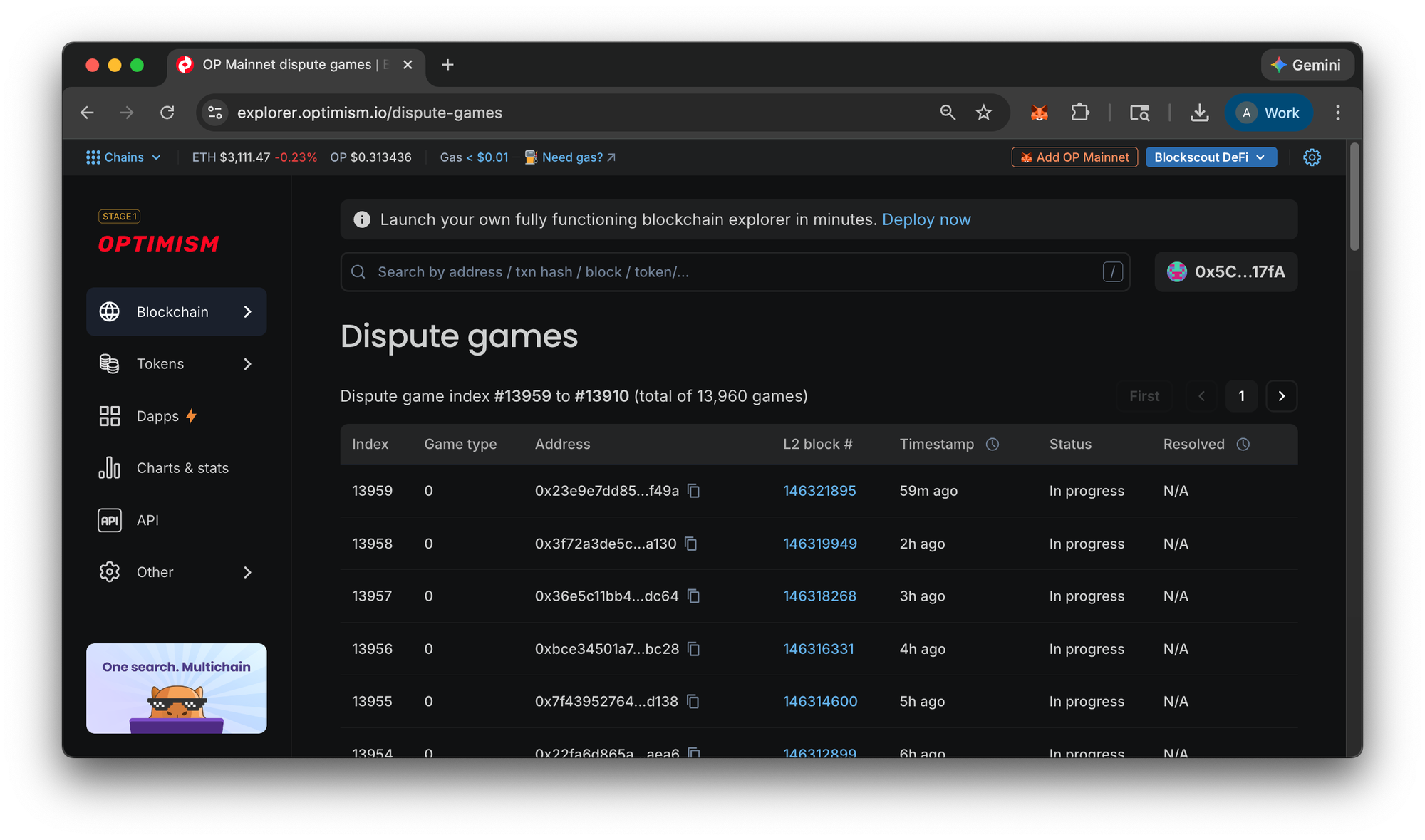
Blockscout provides specialized features for rollup explorers including batch viewing, dispute games, and blob transactions.
S
Signature
A signature is cryptographic proof that a transaction was authorized by the owner of the private key. When you sign a transaction in your wallet, you're creating a signature using your private key that proves ownership.
Smart Contract
A smart contract is code that runs on the blockchain. Once deployed, it executes automatically when called, following its programmed logic without requiring intermediaries.
Common smart contract use cases:
- Tokens (ERC-20, ERC-721)
- DeFi protocols (lending, swapping, staking)
- DAOs (governance)
- NFT marketplaces
On Blockscout, verified smart contracts display their source code and let you interact directly with Read/Write functions.
Solidity
Solidity is the most popular programming language for writing Ethereum smart contracts. It looks similar to JavaScript and was specifically designed for the EVM.
Example Solidity code:
contract SimpleStorage {
    uint256 public storedData;

    function set(uint256 x) public {
        storedData = x;
    }
}
State
State refers to the current data stored on the blockchain: account balances, contract storage, etc. Every transaction can change the state. The blockchain maintains a complete history of how the state has changed over time.
T
Timestamp
Every block includes a timestamp indicating when it was mined/validated. This isn't perfectly accurate (can be off by a few seconds), but it's close enough for most applications.
On Blockscout, you'll see timestamps on every transaction and block, showing exactly when activity occurred.
Token
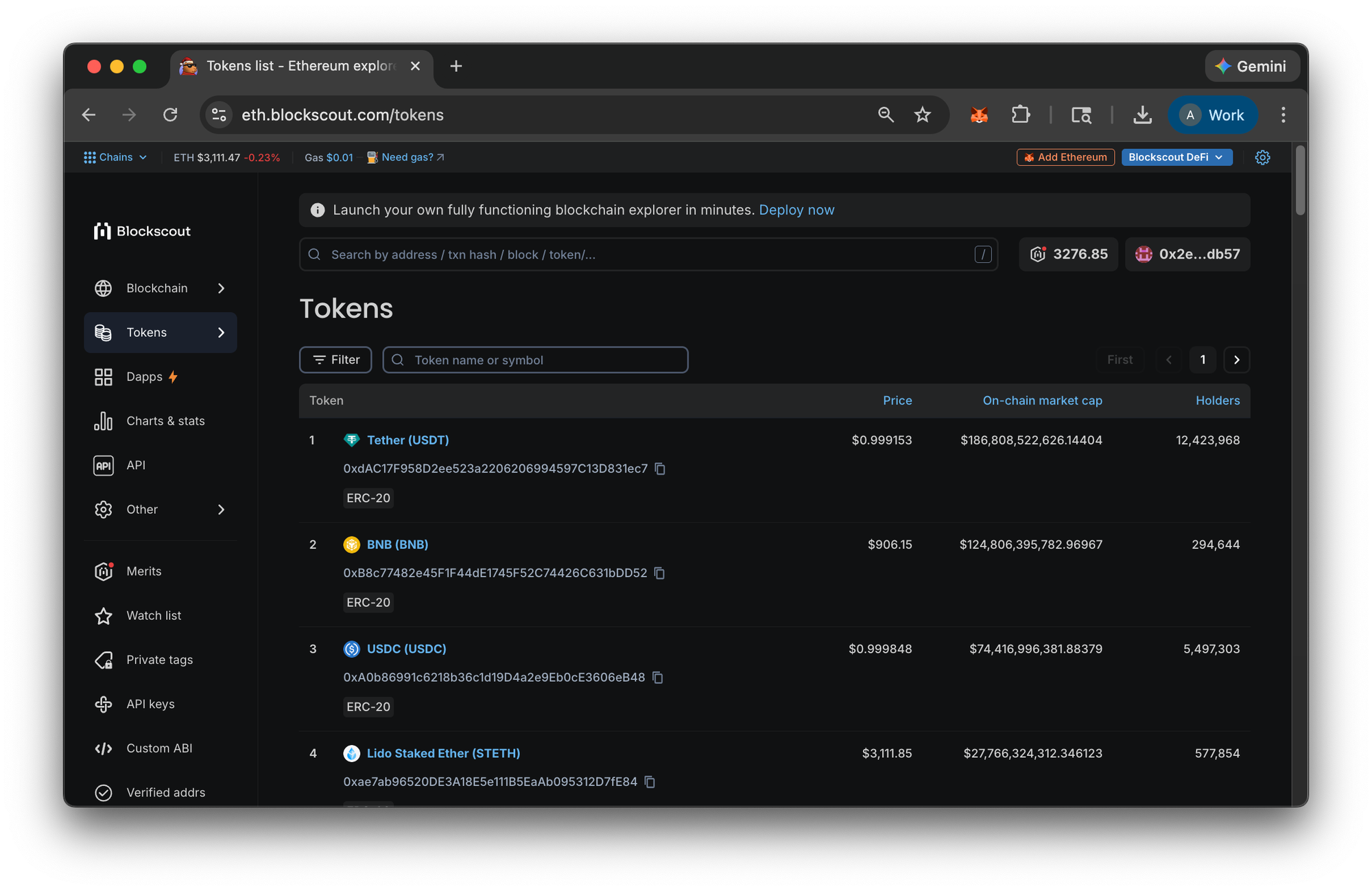
A token is a digital asset created on an existing blockchain. Unlike the native currency (like ETH), tokens are implemented through smart contracts. Common token standards include:
- ERC-20: Fungible tokens
- ERC-721: Non-fungible tokens (NFTs)
- ERC-1155: Multi-tokens
You can track all token transfers on Blockscout by visiting the Token Transfers tab on any address.
Transaction (Tx/Txn)
A transaction is a signed message that changes the blockchain's state. Every transaction includes:
- From address (sender)
- To address (recipient or contract)
- Value (amount of ETH sent)
- Gas limit and gas price
- Data (optional, for contract interactions)
- Signature (proof of authorization)
On Blockscout, each transaction gets a unique transaction hash you can use to look up all the details.
 0xScout
Transaction Hash (Txn Hash)
The transaction hash is a unique identifier for a transaction, like a tracking number. It's a 66-character string starting with "0x".
Example: 0x5c504ed432cb51138bcf09aa5e8a410dd4a1e204ef84bfed1be16dfba1b22060
You can copy this hash and paste it into Blockscout's search bar to view all transaction details.
Transaction Status
Transaction status tells you whether a transaction succeeded or failed:
- Success: Transaction completed as intended
- Failed: Transaction reverted (see revert reason for details)
- Pending: Transaction is in the mempool, waiting for inclusion
Testnet
A testnet (short for "test network") is a separate blockchain network used for testing and development. Testnets use worthless test tokens instead of real cryptocurrency, allowing developers to experiment without financial risk. Popular Ethereum testnets include Sepolia and Holesky. Blockscout provides explorers for multiple testnets.
V
Validator
In Proof of Stake blockchains like Ethereum, validators are nodes that stake tokens to propose and validate blocks. They replace miners from Proof of Work systems.
Validators earn rewards for good behavior and can be penalized (slashed) for malicious activity or extended downtime.
Verification
Smart contract verification is the process of matching deployed bytecode to the original source code. This proves the contract does what it claims and hasn't been tampered with.
Verified contracts on Blockscout show a ✅ checkmark and display their source code, ABI, and constructor arguments. This transparency is critical for trust and security.
 0xScout
W
Wallet
A wallet is software that manages your private keys and lets you interact with the blockchain. Wallets let you:
- Send and receive transactions
- Store tokens and NFTs
- Interact with dApps
- Sign messages
Popular wallets include MetaMask, Rainbow, Coinbase Wallet, and Rabby.
You can connect your wallet to Blockscout to access personalized features like watchlists, private tags, and direct contract interaction.
Wei
Wei is the smallest unit of ether. 1 ETH equals 1,000,000,000,000,000,000 wei (1 quintillion wei). It's named after Wei Dai, a cryptocurrency pioneer.
Common denominations:
- 1 wei = 1 wei
- 1 gwei = 1,000,000,000 wei
- 1 ether = 1,000,000,000,000,000,000 wei
On Blockscout, you'll see values displayed in both ETH and wei depending on context.
Z
Zero-Knowledge Proof (ZK-Proof)
A zero-knowledge proof is a cryptographic method that proves something is true without revealing the underlying information. ZK-rollups use these proofs to validate thousands of transactions while only posting a small proof to Layer 1.
This technology enables privacy-preserving transactions and massive scalability improvements.
Keep Learning with Blockscout
Understanding these terms is just the beginning! Blockscout makes exploring blockchain accessible whether you're tracking your first transaction or conducting deep forensic analysis across multiple chains.
Ready to put your knowledge to work?
- Explore transactions across 3,000+ chains with Blockscout's multichain search
- Verify smart contracts directly in the UI
- Track tokens, NFTs, and DeFi activity
- Use advanced filters to analyze on-chain data
- Connect your wallet for personalized features
The more you explore, the more these terms will become second nature. And whenever you need a refresher, bookmark this glossary. It's always here to help!
Have questions about a term we didn't cover? Drop by our Discord community or follow us on Twitter/X where our team and community are always happy to help.
Happy exploring! 🔭
Updated: January 2026