
Every Contract Deserves a Name: Enscribe Identity Scores on Blockscout
Learn how Enscribe Identity Scores add ENS-based contract identity signals directly to Blockscout explorers.

Smart contracts are precise, but they are not readable.
Dealing with a protocol often requires reading long hexadecimal addresses from documentation, dashboards, or transaction history. Besides the fact that identifying contracts by 0x830somethingC706 is error-prone, it is also difficult to tell whether a contract is official, deprecated, upgraded, or even legitimate.
There is no way to tell from the hex alone.
To improve this, Blockscout now integrates Enscribe’s Identity Score directly into contract pages across supported EVM explorers. This new widget introduces a simple but meaningful signal: how clearly a contract is identified onchain.
First, Let’s Describe Enscribe
Enscribe is a smart contract naming platform that allows teams to assign human-readable, verifiable names to smart contracts using ENS.
Instead of interacting with something like:
0x830BD73E4184ceF73443C15111a1DF14e495C706
You get:
auction.nouns.eth
These names resolve onchain via ENS. They are public, verifiable, and tied cryptographically to the contract address.
Enscribe supports naming at deploy time, so a contract and its ENS name can be assigned atomically in a single transaction. It also allows teams to retroactively name existing contracts, attach metadata, and manage their contract inventory across multiple networks including Ethereum, Base, Arbitrum, Optimism, Linea and Scroll.
The goal is simple: give smart contracts a real identity.
The Identity Score on Blockscout
With this integration, every supported contract page on Blockscout now includes an Identity Score widget.
The score ranges from 0 to 100 and reflects how clearly a contract is identified onchain through ENS naming and metadata. Higher scores indicate a properly configured primary ENS name with completed metadata.
The score is fetched directly from Enscribe’s API and updates dynamically based on the contract’s naming configuration. It takes into account factors such as forward-resolving ENS names, primary name settings, and associated metadata.
In practical terms, the score helps you quickly understand whether a contract is unnamed, partially configured, or fully identified. A higher number means less ambiguity and greater clarity.
Where to Find Enscribe on Blockscout
You can find the Identity Score in the Widgets section on any supported smart contract page across Blockscout explorers.
For example, on a contract page you will see a widget displaying something like:
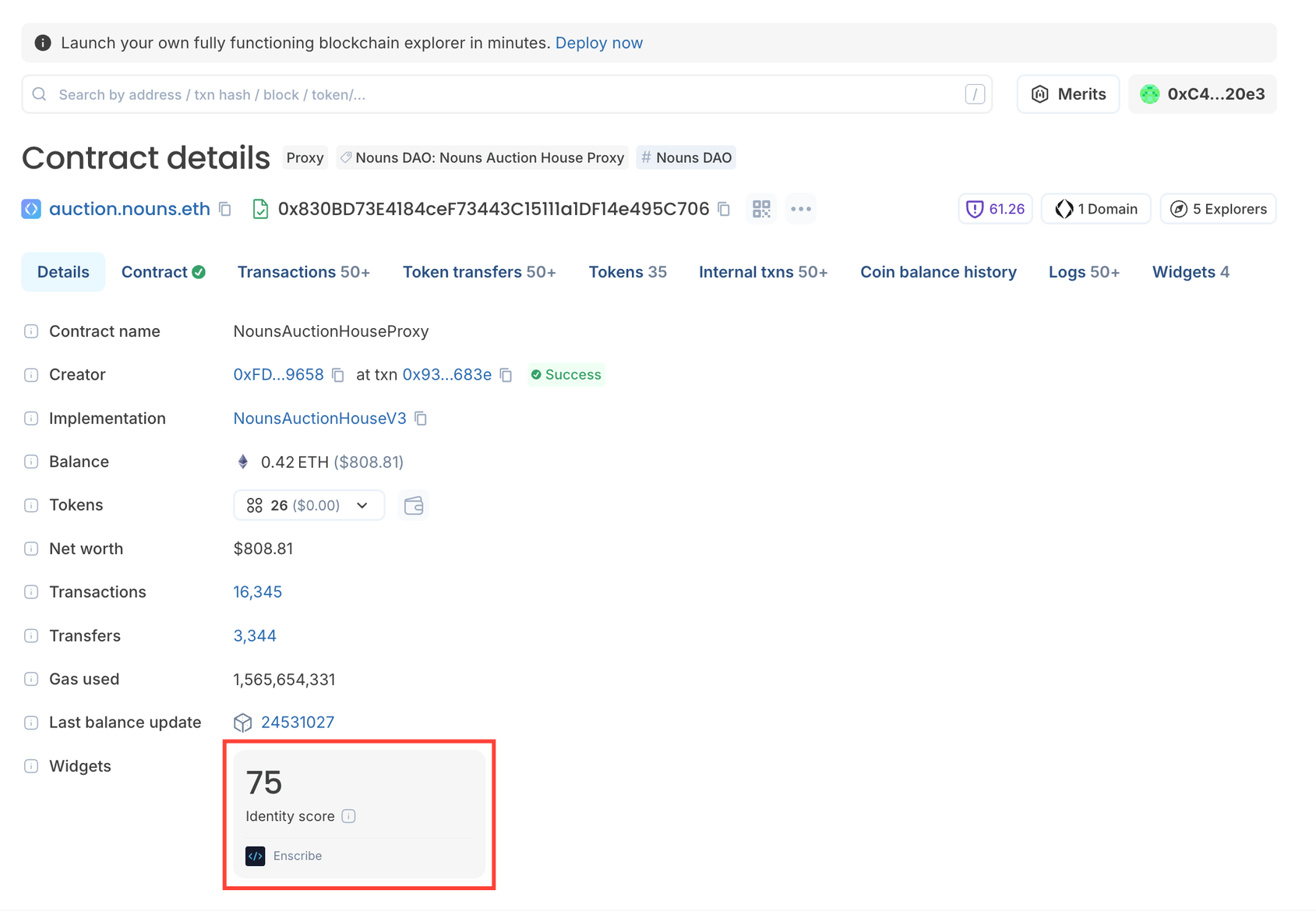
The score does not replace the ENS name display in the contract header. Instead, it complements it by adding a measurable identity signal directly within the explorer interface.
Click Through: What’s Behind the Score?
Clicking the Identity Score takes you directly to Enscribe, with a full breakdown of the relevant contract.
From there, you can:
- View the ENS name associated with the contract
- Confirm whether it is set as the primary name
- Inspect metadata
- Check expiration details
- See ownership and management information
- Review associated and owned ENS names
If the score is low, you will understand why. If the contract has no ENS record, you can name it. If metadata is incomplete, you can improve it. The widget reveals information that is both insightful and actionable.
Explore to understand
Block explorers are built for transparency. They show transactions, logs, bytecode, proxy patterns, and verification status. They reveal how contracts behave.
All of that remains critical. But transparency alone does not always equal clarity.
As protocols expand across chains and deploy increasingly modular architectures, clear contract identity becomes essential for navigating onchain systems safely. Contracts need to be recognizable not just executable.
The Identity Score introduces an elegant identity layer inside the explorer itself. It creates a visible standard for contract clarity and encourages better naming hygiene across the ecosystem.
Readable contract identities reduce errors, simplify audits, and make it easier for users to confirm they are interacting with the intended contract. As EVM ecosystems continue to scale, clarity becomes as important as composability.
Blockscout has always made contracts transparent. With Enscribe, contracts become identifiable.
And that difference matters.